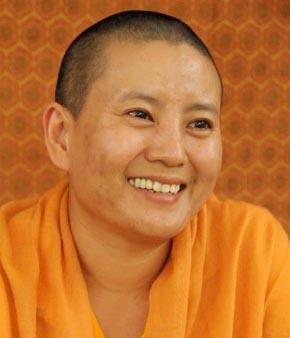

I feel that experiences such as sickness, difficulty, and pain can be blessings in disguise, if only we can learn to perceive them correctly. When I didn't get to study, I developed the desire to educate other kids, and the joy I get from seeing these kids being educated is so wonderful. And because I experienced domestic violence, today I can relate to the pain and difficulty of women who are suffering from domestic violence, and I can be of some service to these people, and it makes me feel so good. Because my mother suffered from kidney failure, I understand the difficulties of people with this kind of disease and was able to develop facilities to help them.
Too much pleasure isolates you, and you become lonely. When you have pain and difficulty, it connects you to people everywhere around you. It's wonderful at times, but I don't mean to wish that people suffer. I hope I didn't talk too much.
Nipun: No, that's great. I would just like to know the name of your guru.
Ani: Yes. My teacher's name is His Eminence Tulku Urgyen Rinpoche. He actually belongs to both the Kagyu and Nyingma traditions.
Question: You lived in Nepal for a long time and then you came to America. I was wondering, what surprised you most about people living in America or in other developed countries? Are they on the right track?
Ani: Who am I to judge? I'm not in a position to judge anyone's lifestyle, but what surprised me most is how when I came to America, everything was about pressing a button. And people all seem to be so busy. They say, "I'm busy, I'm busy, I'm busy. I'm so busy."
Nipun: That's 98% of the people here. [laughter from the audience]
Ani: Well, the funniest thing I remember is before I left for America, my teacher's elder son, said to me, "So you're going to America?"
I said, "Yes, so please bless me."
He said, "Just be careful. Very interesting people live in America."
I was curious and asked him, "Why do you say that?" I remember his answer very clearly. He's very funny and makes people laugh a lot.
He said, "The people in America love to suffer before the suffering comes."
Question: Is there a book about your guru?
Ani: Yes, many books from the Rangjung Yeshe Publications: Rainbow Painting. As It Is. Blazing Splendor.
Nipun: And you've got a book titled Singing For Freedom.
Ani: Yes.
Nipun: Can you share a little bit about the title itself?
Ani: I'd say intellectual people shouldn't get this book. It's just a simple story of a girl who chooses not to suffer in her life. She looks for an alternative—a transformation. The reason I titled it "Singing For Freedom" was because of the journey I made to free myself from my own anger towards society—especially towards men. The frustration and hatred that grew in me, burning me, was my own struggle to free myself. I don't know how much freedom I've been able to bring to others, but this was my journey to freedom.
Through singing as a spiritual practice, meditation practice, the impact on those who listen to my singing, and the resources it generated towards facilities to educate girls, I began to make myself lighter and lighter—more fulfilled, I should say.
I'm still in the process of healing and freeing myself. Some people have the wrong notion that a shaved head or red robe means someone is totally enlightened. Trust me, they're not. According to our culture, we expect people to bow down to us and make offerings of the best foods. But we are sometimes in worse danger of ignorantly developing an arrogance for being someone who does good. Being a nun means refraining from evil deeds, or rather engaging in virtuous deeds..
One experience made me feel so filthy. We were having puja, a big ceremony, and our sponsor was arriving, Some of my nun friends and I were discussing, "Who is the sponsor of today's rituals of puja?" And then I was saying, "Oh yeah, he's a good one and makes good offerings with good food!"
Suddenly I thought, "Oh my God, what is happening? This is so not good." And from that experience I asked my lyricist to write a song on understanding the worthlessness of wealth and power. I had renounced it all, but in the name of renuncation I had developed so much arrogance. I was deceiving myself.
Now this song will be as my gratitude towards you all. I'm so, so honored, really, to be among you and to share this moment with you. So this song goes like this: “I wish you victory. I wish you auspiciousness in life, but may your heart always remain tender. May your wish for happiness be a wish not to hurt the slightest bit to anyone. In your happiness may I rejoice. I wish you victory in life, I wish you auspiciousness in life, but may your heart always remain tender.” (she sings)
Question: I’m delighted to be in your presence. You spoke about people and circumstances creating grievance and misery. And then you said that all this came into your life only to serve you, or for the better good. Could you share some thoughts on how one can have equanimity with people or circumstances that bring us suffering?
Ani: We human beings are so intelligent, Our analytical abilities are so wonderful. There are times when you have a very strong desire to be freed from that suffocating or unpleasant feeling of being in some circumstances. When you really try then to analyze the whole situation, you find there is no real substance to cling to. That helps you to ask, "What am I hanging on to? What is it that really makes me feel like this?"
I'm not in a position to teach you the exact methods to free yourselves because I'm not a qualified teacher—I'm still learning, but disappointment is a part of our lives. We suffer from what we cannot accept.
When you start to dig deeper into the reasons for your suffering, you want to be able to find something solid and say, "This is it," and then crush it. But you don't really find this in the end. It can make me feel so stupid at times. So when I feel that someone is making me angry, I try to think, "Am I perceiving this correctly? What if I were in that other person's shoes? If I look at it myself in that way, would I still think this?" I try to change the angle of my thinking or perception of whatever incident or conditions I am in. I really try to think.
Sometimes you find no reasons, yet the unpleasant emotions still exist inside, and it feels kind of itchy, like you want to scratch and scratch to the point where you create your own wound. Then you cry about that wound. We are so used to seeking sympathy from other people. We love when people show us sympathy and say things like, "You poor guy, it's not your fault," and so on. And at times we think, "So what?"
When I look back, every incident in my life seems to have had a reason, whether to give me a sign or to help me understand what was happening and bring new opportunities.
Two years ago, we had a really bad earthquake. Everyone thinks earthquakes are the most disastrous thing, and people are still upset about it. Many people were traumatized, many lost their lives or were injured, and so on. What happened, happened. You can't undo these things. There is grief. That's part of the process of life.
After the earthquake, I was so happy to see how a disastrous moment was able to invoke so much kindness and compassion in people's hearts. It was so beautiful! Normally you would not see it on that scale. People are usually busy running around, thinking only of their own survival and how to make more money for themselves and their families.
After the earthquake, everyone started behaving like everyone else was family. And this is what we actually dream of experiencing in normal life. We have to struggle really hard to invoke such behavior, feeling, and attitude towards life and the people around us.. Of course that doesn't mean there were no regrets for injuries and precious lives lost. But at the same time, I also found so much opportunity to serve. I was like, "Wow."
Before that, I didn't have the courage to think of adopting 125 children affected by the earthquake—victims who lost parents in one way or another. I was happily taking care of educating 80 to 90 girls. After the earthquake, I built up the courage, with the help of my little nun there [who is present at the gathering], to take care of 125 children and put them in boarding school. And today we've been able to do that.
Every situation in life has certain opportunities that you can grab. I'm not saying this from an intellectual standpoint. I just experienced it and was able to take it in this way. It made me happy, really happy, that I had the opportunity.
Nipun: One of the things that seems apparent to me in just our few interactions is that you are non-calculating. You're not asking, "Is this a concert hall, or is this just a home?" How do you stay true to that non-calculating nature in the music world, where it's very calculating?
Ani: I do calculate sometimes. I've learned to do that. This is one of the very early experiences in my life, when I first came to America. Every time before I went on stage, Steve asked me, "Ani, are you nervous?"
I was really not nervous at all. But he kept on asking me every time before we went on stage. He said, "Are you nervous?"
Slowly, I began to think it’s important to be nervous, so I learned to be nervous—but of course a little less nowadays. It depends who is in the audience. When some of my respected teachers are there, it makes me feel a little nervous—especially because of our cultural thing. Our teachers are always highly regarded in very respectful form. But in the auditoriums you are always on a stage, which is higher than the audience, and the audience is down there, and in the front row are some of my masters, my teachers. Then I feel like, "Oh my god". Yeah, that makes me nervous.
But regarding calculated things, when Krishna organized this tour. I was a little bit concerned for him whether he would be able to sell really well or whether he would lose money. It costs a lot of money for us to come here, and of course there's a certain amount he has to raise for us to go home with.
I'd heard that ticket sales hadn't been that satisfying, especially in San Francisco. I really didn't want the organizers to lose money. In one sense, we say, "Money is not so important". But then money sometimes is important. It does play a role in bringing some convenience or in lessening your concerns or worries. I am a little bit concerned about that. For that reason I do some of the calculations. When I have concerts in Asian countries, I am so relaxed—I don't have to worry about anything. But here in America, calculation is there.
Question: Did you ever have this question for yourself: "What's my purpose in life?" What was your answer for that?
Ani: Rather than asking about myself, nowadays I more frequently experience deep gratitude towards life—what has been, and what is in my life—and what is on the way. I'm so grateful I’ve been able to develop such a perception towards life that brings me more joy than disappointment. I know it’s possible to bring in joy just by making small changes or modifications to your angle of perception.
At times, due to some habitual pattern in our life, we are not immediately able to perceive correctly. But then I'll think, "Maybe this could be the better angle to look at it." When I try to do that, the results are much better. I'm very grateful for that ability.
When I see the smiles on people's faces after I sing to them, it makes me feel like I'm useful—my existence in this world is meaningful. It gives me a wonderful sense of joy, just feeling that I'm useful. I don't really question what exactly I'm supposed to be doing, how much I should do, or for how long.
Life is very impermanent. Just from one earthquake, I can see that any moment could be our last. My teacher says, "Our life is like a little lamp in the wind. It is always in danger of going out at any time." I try to focus more on what I can do rather than how much, for how long, or on what scale I am able to do.
Question: You were talking about the spiritual ego—the arrogance that sort of creeps in from time to time. Do you have any specific practices that you do to work with that, besides just noticing it when it comes and bringing awareness to it?
Nipun: Can we just have the next question right now? The first question was around specific practices.
Question: I feel so blessed. I'm from China and this is my first trip to the US, just the second day. I'm interested what you experienced when the money started coming in. Did getting money cause you any emotional disturbance or trouble? How did you handle that?
Ani: I'm happy to see a Chinese brother here because nowadays I do travel a lot to China, and the hospitality that I experience in China, nowhere else is it like that. Every day makes me feel like it's my birthday. So I’m grateful, really. And the question earlier was ...
Nipun: The first question was around practices and the second was around relationship to money.
Ani: In the early stages, it made me happy to have money because I knew where I needed to use it. But the most confusing and difficult thing to deal with is the banks and taxes. It's beyond my capacity of understanding. And there's Internet banking. I'm really bad at that. Sometimes the bank calls and says, "Would you like to invest your money?"
I say, "I don't know, I don't understand these things."
They say, "Your money is just lying there. You must invest!"
I say, "Okay, what does that mean exactly?" That just brings in more confusion.
I feel really happy when I have the money to give to my hospital or to buy things for my school and my children. Right now, I'm looking for a laptop for my three students who are becoming Tibetan doctors. At my last meeting with these students, I said, "What do you guys need?" And they said, "It would help us if we had a laptop to keep records of herbs, pictures, and so on." I said, "Okay, I will bring you a laptop."
And I need to buy an iPhone, too. Last month, the doctor with whom I established the hospital project called me and said, "Ani, congratulations! We succeeded in starting the category donors."
What this meant was that one brain dead patient could donate two kidneys, reducing the need for live donors. This could also mean that illegal human organ trade would go down. And in the processing procedure, we always give women priority because women have children to take care, so they need to be saved first. That doesn't mean we think of less of men.. But I still feel that women need more help.
When I got this news, I was so happy I wanted to give a big hug to the doctor and I said, "Doctor, I want to give you a gift. What do you need most?"
He said, "I need an iPhone."
So to fulfill such things, money is wonderful.
Question: What sort of practices would you recommend for everyday people?
Ani: How did I deal with things I’ve had to face. That's what I want to share. There was a time when I felt distracted. I experienced being carried away. You see, when you are pampered, admired, and praised all the time, there are moments when you really start to believe, "I'm really something." I think these moments are natural. But when my teacher comes into my mind, my heart becomes humble. He is very highly regarded, a guru of gurus—mahaguru. As a highly respected master, people would come to learn from him and would prostrate themselves before him. But he would always say, " Please, you don't need to prostrate yourselves. I'm just an old man."
When I think of these things I am really humbled. The older and wiser I grow, the more I feel his presence in me. In every beautiful melody I hum, I feel his presence. In every kind thought that comes to my mind, I feel his presence. In every kind word that I speak mindfully, I feel his presence. There are times when I miss him, but when I'm able to reflect, I see that he's never separated from me. Every word of kindness, every thought of kindness, every melody of kindness in my life is nothing but his presence and his blessing. And I'm very sure that that is what I'm able to make people feel—the transmission. That is what transmits through me to the people who listen to my music and who feel positive energy and aura that calms them down or makes them feel good. It is nothing of me but his blessing. I rejoice that I can share his blessing with more and more people around the world. So I feel so fortunate that I am able to experience such thing.
In general, the practice of mindfulness is the real antidote for our arrogance. But for me, thinking of my teacher is the best medicine—my pain killer.
COMMUNITY REFLECTIONS
SHARE YOUR REFLECTION
3 PAST RESPONSES
Thank you for sharing Ani Choying's interview and story. Through Krishna Desar I learned of her 2 years ago, got to see her in concert in Washington DC and left feeling a full heart and soul. I am deeply grateful to Krishna for helping organize the tour. He is such a kind, loving, generous human being. And of course Nipun fro creating service space in the first place so we have this beautiful space to connect. <3
Thank you so much to Service Space for this sharing of Ani Choying Drolma . So many things opened for for me , how to do more good in this world for whoever they might be . Am feeling blessed to read her experience and for Nipun also to for being able to provide a platform to share it with the world at large .God bless both of you .
Thank you for introducing Ani Choying Drolma to me. I am listening to her sing as I write this - her voice is truly transcendent and peace-giving.
Ani's story of suffering is her own, but suffering is shared by all. We all suffer, and in the suffering we have a choice of what lesson we take from it. I thank Daily Good and Ani Choying Drolma for reinforcing in me that compassion is something that is always available.
Namaste.