
Coral slime mold
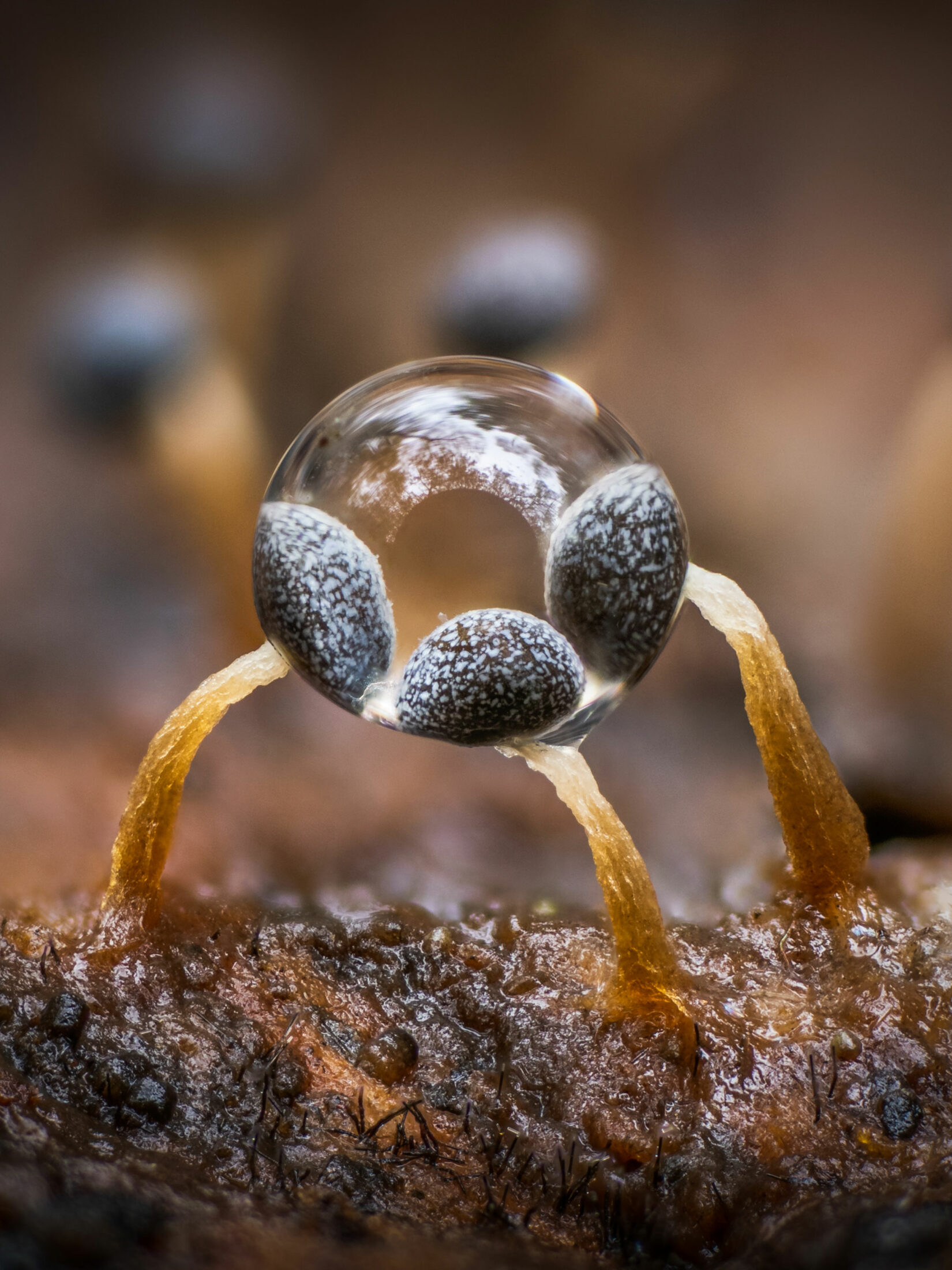
Physarum, in droplet
THE ACORNS HAD ALL fallen the day I returned to Burnham Beeches to meet Barry, Gill, and hopefully some more slimes. The late autumn sunlight was gentle and warm, belying the chaos these unseasonal temperatures were beginning to unleash on our planet.
For the fifth or sixth time that month, it was so hot I had to strip off my normal November jumper and coat. The hollyhocks in our garden were re-flowering, and so were the lilacs. Leaves brightened the roads like fireworks, but people outside wore T-shirts.
On the radio that morning, the latest prime minister had decided he would in fact attend the latest major climate crisis summit. “Investment zones” in which habitat can be newly destroyed were still under discussion. Soup had been thrown over a famous painting in protest over the UK government’s refusal to stop using fossil fuels.
Shortly after we met, Barry picked up a leaf which was dotted with tiny “flat cap” slime mold. We stopped at the side of the path, under birch, and time melted as we found leaf after leaf, twig after twig, studded with jaw-dropping structures. A little further up, he directed us to a large log, which turned out to be a hotspot. Gill told me wondrous facts about how saffrondrop bonnet fungi leak bright saffron if touched; how raindrops pop the “eggs” out of bird’s nest fungi; how magpie inkcap ink was used to sign the Magna Carta—at least, according to folklore. We nosed around, stunned and awed, wondering why no one else was here. The wood glowed golden, orange, yellow with the dominant beech trees. It was too warm, too beautiful. We found clumps of eyelash fungus, and hundreds of fruiting bodies of Arcyria slime molds: golden, purple, and maroon. The one “dead” tree was a feast of sacred geometry, a banquet of substrate and life.
In the woods, everything is alive, everything is animate.
LATER, AT HOME, I looked at a small piece of wood from the garden under my microscope. The wood was crawling with life. One mite flomped around yellow strings of plasmodium. A springtail appeared, like a miniature midnight-blue wood louse, horned and cute. A clear glass eel wriggled around black hairs. There was so much frass.
A number of the golden fruiting bodies were bursting. Half an hour later the bodies had erupted and changed shape. They had new curly barnets. I looked closer at another section, this time of Arcyria. The ostiole—the opening through which spores are dispersed—resembled a dilating cervix.
Back to the golden beauties. I realized they were moving. Softly sporulating. Filaments waved like seaweed or tentacles, releasing fine gold dust into the air.
A mite with floppy antennae that looked like a rabbit trotted around the stalks, nibbling. I felt voyeuristic, privy to my own personal nature documentary.
There was a drop-of-molasses mite, an armored crab mite, a mite made out of ultrasound gel.
I had not thought mites could be so pretty.
I will tread more carefully from now on. I know a little of how many are on the forest floor.
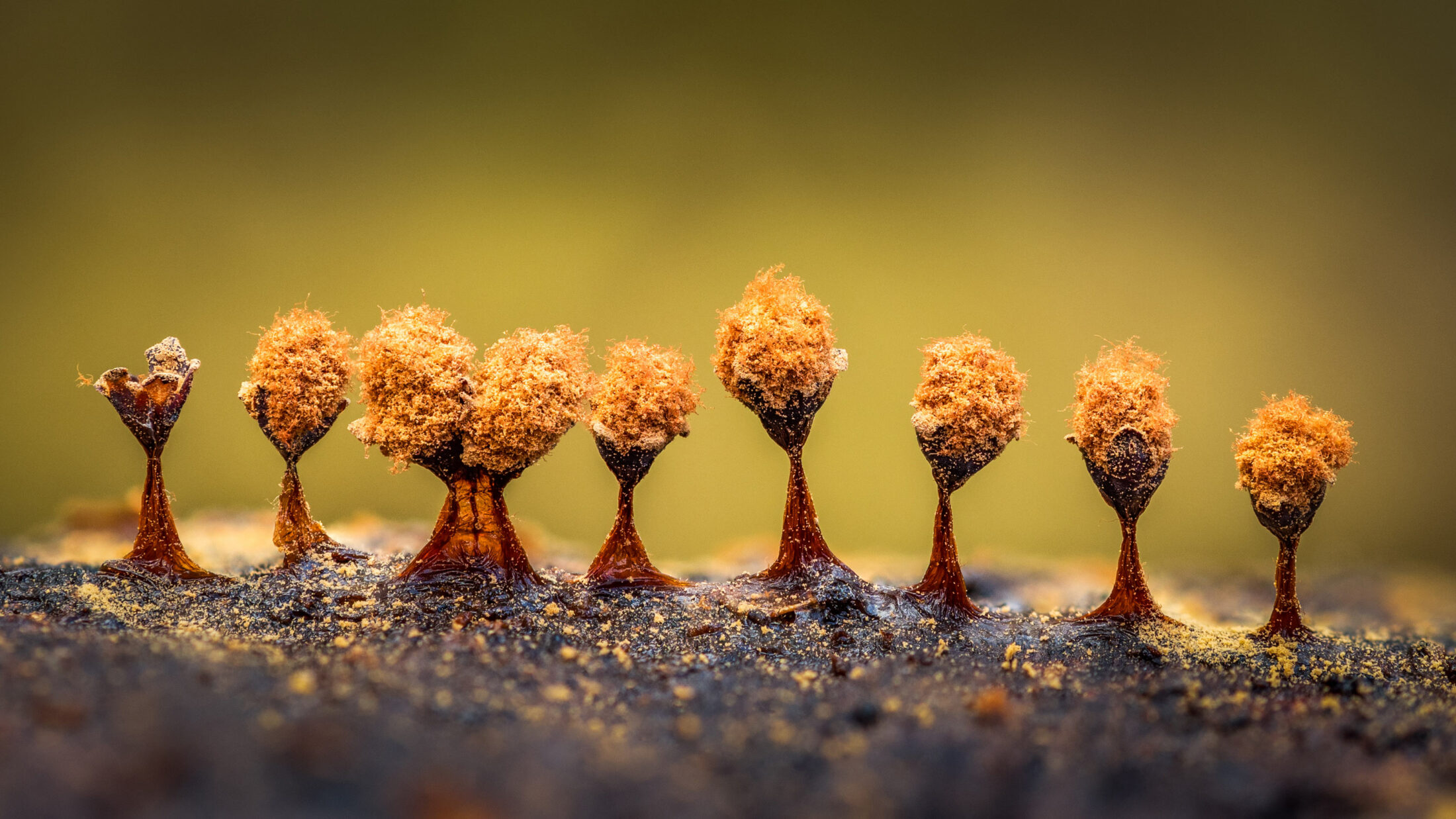
Metatrichia floriformis
AND THEN—WELL, I found my burning bush.
I was sure there must be tons of slime mold in the cemetery next to my house, a peaceful haven in this town. I’d asked the council over the summer if they could leave a pile of dead wood for insects after a tree came down, and I had a feeling it might be a good place to look. It’s in a shadowy part of the cemetery, underneath thick and old yew trees, surrounded by gravestones from the nineteenth century.
I walk there and find the underside of a log of a pine tree glistening—yes! Woah!—a thick slick of bright yellow plasmodium.
Let me make myself clearer about how remarkable plasmodium is. Plasmodium has no brain or nervous system, yet it can perform brain-like, intelligent functions. It knows itself. It is able to learn and anticipate. It can learn, for example, to avoid something potentially harmful. It makes decisions.
I track it day after day. Some of it blobs into globs that hang down and form bright yellow balls which turn blue-gray with iridescence. I can identify it after this happens: it is Badhamia utricularis. The rest of the plasmodium stretches to almost a meter and moves and moves and
Pulsing pulsing pulsing this way this

Stop

Pulsing

Pulsing

Pulsing

Back back back back

Food!

Crawl yellow dendrite creep closer closer
Then ur nd rnd the fngl dbrs Swllw sphxt cnsm slrp Swell go crawl creep up across over Pause Slower slower slower Over grooves of yew Over spikes of leaf Under plates of bark Xylem and phloem Vanish, somewhere, gone. But here, in me, in our enchantment, my wish to you.
I lie down in the cemetery next to the plasmodium and try to listen to it, to contemplate it. I hear the sound of the cars and buses on the road, the gulls above, magpies, machinery, a dog barking, the roar of trains. What is it thinking? I take a note of where it is and notice that twenty minutes later it has moved the length of a grain of rice. I’m awed by its locomotion. A yellow slime moving around next to me. Sharing the same air as me. The same home. The same placenta.
I return again the next day, and I can’t stop staring at its fractal shape. The way its yellow branches so directly and intentionally. Neural rivers of xanthic goo. Just like the veins of our bodies, and the vessels of our eyes, and the branches of the trees, and the clouds above, and the dendrites of galaxies. Blebs pack together, river networks of slime fan and spread. Slugs, worms, springtails, and spiders attend. It abides. And
Veins wiggle and branch like my
Veins wiggle and branch and the trees’
Veins wiggle and branch above.
The fractal shapes in slime molds dissolve the binaries and boundaries collapse.
I feel the slime mold in me.
As our systems fail and break down, what will map our exodus?
I WONDER IF people love the fruiting bodies because they are strangely familiar looking. The hairs of the Trichia look like man-made fibers on a teddy bear. Many resemble human-made confectionery. Others look like they’ve got bombastic hairstyles. Maybe we are not so different.
Perhaps we like them because they are always in a crew. Friendly. On a slime mold group online, we discuss collective nouns. A glitter ball of slime molds, someone suggests. An orgy, a ghostbuster, an overthrow, a slitheration, a slimmering. I suggest a galaxy or a shebang or a sweetshop.
Slime molds have things to teach us. That a being can change but at the same time remain itselves—to use Octavia Butler’s phrase. That there is life and beauty in rot, in decay, in decomposition, in the ashes. That a hallmark of life is evanescence and ephemerality. That our limited, Romantic understanding of the world—“ew, slime”—is outdated. That nonhierarchical, nonbinary being is part of the reality of the world.
It is hard, sometimes, to love slime molds. They are fleeting and fugacious. There one day; gone the next. They make us face the facts: that nothing lasts forever. That ultimate human control is illusory. That we might be at the top by force, but we are not at the center. But I think this is why we need to know them. Our rational, materialistic worldview obscures transcendence and awe. Our culture of forgetting, rejecting, ignoring the wider world requires some work, some assistance, to undo.
How do we see the world as sacred again? By radical noticing. Looking for awe in all of life. Following the wonder in our bodies electric. Before we find new stories, don’t we need to sit and remember? How to venerate the world?
More and more, I think a solution is awe. As Dacher Keltner’s work shows, awe seems to orient us to things outside of our individual selves. It suggests our true nature is collective. Studying narratives of awe in cultures across the world, Keltner and colleagues found that a common part of natural awe is the sense that plants and animals are conscious and aware.
I try and listen again. Perhaps slime molds just want to go about their damn business. How? On dead wood, debris, twigs, leaves, all the stuff we tidy away judiciously and ignorantly, not realizing that we are destroying exquisite jewels.
As our systems fail and break down, what will map our exodus? Slime molds invite us to look with wonder at what is small and overlooked. Perhaps they can help dismantle our delusions of human exceptionalism—with their absurd hidden ethereal beauty. They can dissolve the boundaries we pretend exist—with their remarkable metamorphoses. They can challenge our stagnant cultural notions—with their existence as both collective and individual. They can humble us—with their complexity which is beyond our understanding. We think we have mastered the natural world, yet we don’t know how a slime without an apparent brain can conduct itself intelligently. We think we can bend the Earth to our will, but we know barely anything about microorganisms. We think we are in charge, yet we know next to nothing about the slime around us that reigned on Earth for a billion or more years.
The cemetery slime mold slicks onto a twig, so I take it home and feed it. It grows and it grows and it pulses and it flows and there is the sublime. Now, I see that slime molds are everywhere. Give me a garden, or a woodland, and I will show you.
Can slime molds be symbols of hope, too? I think so. They tell us that our ways of being can be different, that we have little idea of the possibilities of life on Earth, that the boxes and straitjackets society puts people into can be busted open, and that new stories and old stories can take us somewhere kinder, fairer, wiser, one pulse at a time.
COMMUNITY REFLECTIONS
SHARE YOUR REFLECTION
3 PAST RESPONSES