
came back with silk and spices.
Have you heard that expression, "when my ship has come in"? When that ship has came in the people who had invested in it made a lot of money. That's why that expression has persisted in the English language to now. People say that when they have an IPO – “my ship has come in.”
If your ship didn't come in and your ship sank, you'd go bankrupt. They would try to put you in debtors prison, which was not a good place to go. A deal was struck, and this was the beginning of corporate capitalism. That deal was that the king gave entrepreneurs what they most wanted, which was immunity from going into the debtors prison. Today we call that “limited liability.”
In exchange, the king got some shares and he got to collect taxes. Nothing's changed. But there was one other provision. In order for the king to do this, the purpose of that company had to be the greater good of the people. In order to get a royal charter, to get limited liability, the company had to do something for the people the king could not do—improve their lot, sanitation or water or food. That was the first corporation. Simultaneously in London and Amsterdam in the 1740s 1750s.
The first corporation in the United States was Harvard College, which was created along those same terms. I don't think too many companies in America today would think that their purpose was the greater good. I mean, we have people who are trying. We're in Silicon Valley here and how many of you work for companies here? I did. Yeah, it's hard. It's hard. And it's one of those yogas that maybe we should call it corporate yoga.
Did any of you read the book Becoming Steve Jobs? It's the better of the books about Steve. It opens with a scene that I know is true because it was me. I was kicking Steve out of a meeting. It was the second meeting of the Seva Foundation. We were having it in California, although Seva was started in Michigan. Steve gave us the money to start Seva. He was a member of Seva. In my book you'll see his application to become a member. I put that in just so there would be no doubt about it.
He gave us the money, and he gave us the technology, which was an Apple II, number 13, a Corvus hard drive and a Hayes modem. He called me one day and he said, "I have the answer to what you need in order to run blindness program, it's an amazing new piece of software, a spreadsheet. It’s called VisiCalc." He said, "I'm giving you so much memory on the hard drive you'll never be able to use it all. It's 5 Megs."
I said, "What's a spreadsheet?"
Steve was part of the development of the Seva Foundation.
In that meeting there was Dr. Venkataswamy and Nicole Grasset, who had worked in smallpox, and Ram Dass, and Wavy, and so many wonderful people were in the room. Steve came after having had the first meeting of the board of directors of Apple. Arthur Rock became the chairman and Steve had just gotten a new suit, and a new Mercedes. He was trying so hard to be a good corporate citizen, and he drove from Palo Alto to Marin and he was tired. He got out of his car and walked into the room; he blew past everybody there. He said, "The way you've got to build Seva is like this. You've got to go call Regis McKenna. You gotta bring him in. You've got to do marketing."
He got a little ahead of himself and I kicked him out.
He sat in the parking lot in that new Mercedes, in his new suit and his roommate from Reed, Sita Ram Dass, was with him. After an hour and a half, Sita came up to me and said, "You know, Steve's still here."
I went out into the parking lot and stood by the car and Steve looked at me. He opened the door, and we hugged, and he cried. He was sitting in his car crying.
I said, "Steve. It's okay. Really. Come on back in. All's forgiven."
He said, "No, I messed up. I was wrong. Everybody was right. I was wrong. I was arrogant."
I said, "Come on back in. It's okay."
He said, "I will come in, and I will apologize, and then I will leave.” He said, “Larry I have two beings in my head. One is with Arthur Rock and my shareholders and the other is with everything that Seva represents. I'm both people. I’m still the kid at Reed who took LSD and who snuck the name of of "RAM" (name of a god in Hindu mythology) inside of every Apple II. These two beings in my head, they're at war with each other.”
[Larry pauses, and says, “What, you thought it was Random Access Memory?” laughter]
I'm reminded of the Native American admonition, when a young brave goes up to the elder and says, "How will I be able to lead a light on the righteous path?"
The elder says, "There are 2 wolves inside of you. One is spewing hatred and venom, and the other is talking about love, and peace, and harmony."
The young brave says, "Which one will win?"
The elder says, "The one that you feed."
That was Steve in that moment.
I'll tell you about a story, harder for me, that takes place closer to Steve’s death. My wife and my son both developed cancer within a couple of months of each other. My son was 27. He was working for Steve. He was a China Scholar in Beijing, and he reported directly to Steve. He sent him a letter about the Chinese attitudes towards Apple. Steve loved him.
My wife developed breast cancer and my son developed lung cancer. When my wife first developed cancer, Steve called me up. Steve had already been diagnosed with pancreatic cancer. He knew all the docs and had been through chemotherapy. He called and said, "I'm going to send you a spreadsheet." He had sorted through a hundred cancer surgeons and ranked them on which one had the best outcomes, which had the best bedside manner, and which were in hospitals that had lower infection rates. He'd scored each of those qualities and sorted and ranked them, and came up with 3 names. He had called them and interviewed them, and he recommended 2 of them to my wife for her cancer surgery.
When my son got cancer he did the same thing. This wasn’t handing it off to an assistant. This was Steve.
Then when my son was dying, and was taking different chemotherapies, Steve would call him every Thursday night and ask, "What chemotherapy are you taking? Oh, I've had that one. Ah, it'll make you sick to your stomach; you'll get the shits, but you'll be okay." They would have cancer satsang.
So I know a different Steve. I think it's hard to understand the pressure on him, but you know, there was not a day that went by that there wasn't a Japanese tour bus out in front of his house. When he died there was a whole line of buses just waiting to pass by.
He would always walk from his house to the yogurt stand in Palo Alto. He always wanted to be just a regular person. His house had no locks on it. He tried to raise his children in as normal a way as possible. The pressure on him was such that he became a very private person. I wish everybody had known him the way I did. I met him when he was 19. I met him because he came to meet Neem Karoli Baba, but he got there 6 months late since Neem Karoli Baba Maharaj-ji had already passed away.
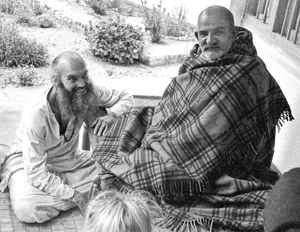 Question: Could we speak a little bit about your association with Neem Karoli Baba and Ram Dass?
Larry: I was an intern at Presbyterian Hospital, which is now called California Pacific Medical Center and as an intern I got one day a week off. Baba Ram Dass had come to San Francisco and was lecturing at the Unitarian Church on Geary and Franklin on Thursday night for three weeks. That was the night I had free, and my wife and I went.
We knew noting about all this, about India. Nothing, period. Ram Dass had just come back from being with Mahariji, and it seemed like he had a searchlight in the middle of his forehead, and he was transmitting something that we wanted. We couldn't have named it. I still can't name it. It's above my pay grade, too, but I knew it when I felt it. You all know it when you feel it, even if you can't name it.
He was talking about this mysterious guru. If you read Be Here Now, there's hardly any mention of who he is, just that he is. We were intrigued. We kind of filed it under mysterious things to do, and then two years later— this all goes in the serendipity category that Nipun was talking about.
After we drove our magic buses from London, through Europe and Turkey and Iran and Afghanistan, came to Pakistan, came into India, we were really hungry and tired. We had no money, we were ragged, and we did what everybody did at that time, which is that we went to the American Express office to get the money that we hoped had been wired to us from our parents or friends.
We drove into Connaught Circus, where the American Express office was. We parked our two psychedelic buses on the road, and a delegation went into the American Express office to start picking up our mail.
Wavy and my wife went in and Wavy wound up standing in line right behind Ram Dass who had come back to India. He was standing in line to receive what he hoped would be the first copies of the book he had written Be Here Now. He got two copies of the book and immediately gave one of them to Wavy, and inscribed it, "To Wavy Gravy and the Hog Farm Family, the Hanumans of the '60s."
That night we all had dinner together at the Kumar Art Gallery. All the people with Ram Dass were wearing white gowns and had beards; they were clean and scrubbed, and looked like they hadn’t eaten for a long time, and they looked very saintly and sacred. We all had leather and boots, and were kind of the macho hippie tribe; they were the ethereal angel tribe. But we knew that we were branches of the same tree. We knew that we were seeking the same thing.
My wife, who is much smarter than me, stayed and started taking meditation courses. I went back to San Francisco with Wavy. He was sick, and I was his doctor. Then India and Pakistan began a little war, 1971. Pakistan was bombing areas around the Taj Mahal, where Mahariji's other ashram was, Vrindavan. He sent everybody away. “Jao, jao, jao.” It means “go, go, go.”
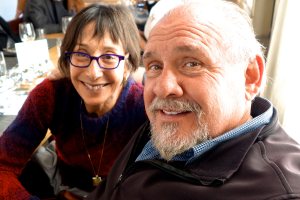 My wife, who had been Elaine when I left her, was now Girija. We negotiated the terms of our new arrangement: if she came home to be with me for Christmas, which I wanted, I would agree to come back and meet this fat old man in a blanket who I was deeply suspicious of. I thought she'd been captured by a cult.
I can tell you unlimited stories about Maharaji, but I'll tell you the one that Nipun was talking about earlier. Let me start off by saying what it was about Maharaji that got the scientist in me. After I had dealt with the idols and the foot touching, which is a not very American thing, and the kind of cult-like scrum that happened every time he came out of the door—all the devotees would just jump all over to be close to him—all those things looked to me like a cult. I got past each one of them.
One day I was sitting with him, and he held my hand, and went into that samadhi space that he went into. He used to do japa— counting off the names of God with a rosary. He would take each articulated joint of a finger and he would say, "Ram, ram, ram, ram, ram." I was holding his hand, and he was doing japa. He was off in some place that maybe I get to visit for holidays every once in a while, but I don't get to stay there.
I looked at him, and I could feel that he loved everybody in the world, unconditionally.
I was trying to reconcile my scientific mind with this feeling that I had that he loved everybody, and then suddenly, out of nowhere, I started loving everybody in the world! I didn't know that this machine came equipped with that app. I didn't get an operating manual, but I’d never felt like that before. I certainly didn't feel like that when I was part of SDS, or when I was fighting—even though I was fighting against the war in Vietnam. And I didn't feel like this when I was a doctor fighting for moral rectitude. I didn't feel like that when I was a hippie and a hedonist, and a happy hedonist. But I felt like it then.
Over the years, there have been all these legends about Maharaji being able to predict the future, or do all these miracles. Some of you might know about the eight siddhis (metaphysical super powers) and all that stuff. It's not that interesting. But being able to change the human heart, now that's something. Being able to make somebody else feel love, that's a trick I'd like to be able to replicate. That's who he was.
There's another expression in India, which is, "When the flowers bloom, the bees come uninvited." We all flock to get the nectar.
Question: When I think about powerless or vulnerable people, shall I help them to become powerful in the sense that our system is describing as powerful, or shall I try to make him/her understand that every power is within ourselves?
Larry: That's a phenomenal question. I probably created the confusion because I gave a very short description of what Gandhi actually said. He said consider the face of the poorest and most vulnerable person you have ever met and then ask yourself if the act that you are considering will help that person. Will it bring him to swaraj? That is a word that almost means freedom, independence, liberty—there are a lot of different translations for it. I think he was addressing physical as well as spiritual vulnerability, and power. He wasn't going to let us off with just feeding the hungry, although he also said famously, "If God were to appear to a starving person, God himself would not dare to appear in any other form than as food."
I think we all kind of understand that there's a basic minimum of physical necessities; food, a place to sleep, roof over your head. You can't ignore those realities and just feed the soul. I think we all really understand that you have to do both. Gandhi said, ask yourself if the act you will contemplate will help that person receive Swaraj? We might even translate that in the Christian sense as salvation. Will the act that you are doing, will it help lead this man to liberation?
Question: Having used vaccines to eradicate smallpox, what do you feel about the current vaccine controversy? Perhaps there's some health consequences to the over immunization of humanity?
Larry: This may not surprise you that it's not the first time I've been asked that question. The word vaccine comes from vaca, which means cow. The reason it comes from the word cow is because the first vaccination ever given was to a little boy named Danny Phelps, and it was to protect him
It was a crazy English eccentric doctor who got this idea that if you took the oozy puss from the utter of a cow—we call that cow pox, vaccinia—if you took that and cut the boy's arm and put the puss of the cow in there, he would be protected against small pox. You could take this young 7-year old lad in Berkeley, England and you could send him off into a crowd that had smallpox and he'd be safe.
If I saw that, I would be a vaccine resister. That's crazy. There were no microscopes yet. We didn't have germ theory. This seemed like magical thinking. But it turned out that the crazy doctor was right.
I can assure you there were no vaccine trials, no double blind trials. NIH didn't fund anything. We had that vaccine for 200 years. I'll just use that one vaccine as an example.
1967 was the summer of love. 1965 was when Larry and Surgy were born. Between 1965 and 1967, 10 million children died of smallpox. Probably over a billion people were vaccinated against smallpox and 18 died from the vaccination. Hundreds got vaccinia, got cowpox, some of it disfiguring. All through the course of the vaccination program, we probably murdered 200 people from the vaccination. This is a disease that killed half a billion in the 20th century. It killed tens of billions from Pharaoh Ramses the 5th who's the first known person who died of smallpox until a little girl named Rehema Bonu who was the last known case of killer smallpox.
What do you do with that information?
No vaccine is perfectly safe. That's an illusion. Some vaccines are stupid, like chicken pox vaccine. Before the vaccine was brought into use, 86 people, on average, died every year from chicken pox. Is that worth going with a nationwide vaccination program? I don't think so. But measles, on the other hand—which is the most contagious disease, maybe, in the world—measles is a really bad disease, especially if you get it when you're older.
Measles vaccine is wonderful, but it was the measles vaccine that was falsely accused of being linked to Autism. A well known, highly respected Journal, Lancet, was gullible, and published a study with 9 children in it, where a man name Hatfield, was paid $500,000 to fake his results to make it look as if the Measles, Mumps, and Rubella vaccine was linked to Autism. You're really talking about the 31 vaccinations that a child has to have before he or she is 3 years old. Is that too many vaccinations? Of course that's too many, but I think probably 27 or 28 are good ones.
By good, I mean that if you're a moral person, and you're not looking at the profit, and you're asking the toughest questions in the world, it's easy enough to decide what you're going to do. We've just gone through how easy that is, you find the poorest and most vulnerable person; you make sure that everything that you you're going to do is going to benefit them, and then you figure out how to take that to scale; and you do all that without attachment. That's easy, because you're doing it just for yourself.
Now, assume omnipotence, that's the government. Try to make a schedule of which vaccines, would it be good for society if everybody had? It would be awful if kids were not vaccinated, and they went into school, and my child had leukemia and your child was on chemotherapy, and they couldn't go to school, because somebody else's child wouldn't get vaccinated. Therefore, they were like a cruise missile to you.
Adjudicating this relationship is the hardest part of public health, because you have to assume that you know what's right for everybody.
I think it's a really tough question. The people who are against vaccination, the world epicenter of which happens to be Marin County where I live—you can see how effective I've been in changing their mind—I'm not going to go into the crazy conspiracy theories and all that, because there's a real, legitimate reason to be concerned about putting anything in your body, the composition of which you don't know, that you're required to do by a government that has not demonstrated a particular skill at compassion.
I vaccinated my kids against everything except chicken pox. I mean, Measles, Mumps, Rubella. I got my daughter vaccinated against HPV. I wish my boys had been young enough, I would've vaccinated them, because it's not fair to vaccinate just girls against a virus that causes cancer. It should be like bingo! You've got a vaccine that protects you against cancer! Nobody should ever have cervical cancer. It shouldn't exist.
These are complicated questions, and everybody's got a different opinion. So I'm glad you asked the question. I'm happy to talk to you more if you want. There's a lot of people, both sides of that issue, good people, and both sides of that issue.
Just one story: when I came back from working in India on the smallpox eradication program, I thought everybody would really be happy to see me. I thought that we'd be welcomed as heroes, but that wasn't the case. People thought that in saving children's lives we were contributing to overpopulation. I would say, at least half of the people who found out that we had eradicated smallpox in the United States of America, thought that.
It turns out that, that's not true. It turns out the best way to reduce population is to let every child live a full life, and into adulthood. That, and the education of girls, are the 2 things that make populations go down. But we didn't know that then, just as we don't know all the positive and negative effects of vaccination. The retrospectroscope is the only medical instrument that's worth a damn, really, if you're trying to figure out big complicated questions like that.
The first meditation course I ever took was one run by Goenka, the Vipassana course. I took it in Bodh Gaya. These were 10-day courses; you'd start with 3 days of anapana breathing, then six or seven days of Vipassana and one day of metta. He would always end every meditation course with a prayer, and I'll do that prayer now: Bhavattu Sabba Mangalam—may all beings be happy, may all beings be peaceful, may all beings achieve enlightenment.
Question: You mentioned that one of the pitfalls of the public health mentality is that you can say that you have the answer that other people need. In epidemiology, there's a sense of truthfulness to it. But in the context of the philanthropy communities you're involved in, what do you think about that difference between helping others versus people determining for themselves what they need, and helping themselves?
Larry: Good question. Well, two things. I'm glad you prefaced it by saying you didn't expect me to answer it. There are some things that have to be top-down. If you need to manufacture a vaccine, if it's 100% safe and 100% effective—the ideal vaccine, which you never get, and there's a desperate pandemic that's killing everybody—it's pretty clear that you’ll get your trucks and go vaccinate everybody. It's not a question of how will a community decide for itself, because it won't have the information; it won't understand what the history of that virus is, and it won't have the vaccine. But that's an artificial situation.
May I ask, did any of you see the movie Contagion? I wrote the first treatment of that movie; I did the science in it. It's a horrifying, frightening movie about a pandemic, and what happens to civil society in the middle of a pandemic. It's isn't just the death and suffering from disease. A pandemic destroys the social fabric, the moral fabric and the economic fabric of society. And under that kind of a circumstance, I'm all in favor of a solution being imposed. But that's pretty rare.
When we try to find out where diseases are, the only place we can go is to the community. The idea that there's anything you can do from a capital city that will help you find out what the problem is just not possible.
In Thailand, which is one of the places where the Skoll Global Threats Fund works a lot, the Thais have produced an app which is called “Doctor Me.” Everybody in Thailand gets it for free. It's paid for by the taxes on cigarettes and alcohol. They use that app to report cows that are sick or chickens that have died. You have a terrific marriage of the community deciding what's important enough to do, and the money from taxes being used to fund that. It's a wonderful example, but we don't do it very often—and there aren't too many marriages that work like that.
Question: I'm wondering what's over the horizon for you now? What's not clear yet, but you have a feeling that you're called to? What are you puzzling about these days and don't have answers for, yet?
Larry: There's an expression in sports, to play “within yourself.” There's so many things that I know nothing about, and then there's many, many things I know very little about, and many more than that that I know just enough about to mess everything up. And then there's a couple of things that I know well. I know a lot about smallpox. I can tell you, you don't have smallpox. I'm very confident of that.
Because I've been in the tech world for so long—and I am, in some ways, a creature and a beneficiary of Silicon Valley and this system—I can live in the valley because I ran two tech companies. I’m not unmindful of the irony and the hypocrisy of that. I'm very grateful, as well—all those emotions all at once.
Because of that, I can kind of see a little bit more of technology than I would have if I had stayed a doctor in Detroit, Michigan, which is where I was born. My day job is I'm chairman of a foundation that deals with pandemics and climate change, drought, and floods, nuclear weapons, cyber-terrorism in the Middle East. We have a wonderful founder, Jeff Skoll. He asked himself what are the things he worried about that could bring humanity to its knees? This is his list. And we work on those things. We do better on some than on others. We haven't done very well in the Middle East, if you didn't notice.
I see there's competing arcs of history going forward. I see progress, technology, as being on both sides of that arc. Again, when I talk about what I know about pandemics and epidemics, technology is both good and bad for stopping these things. On the one hand, if we're going to clear cut all the forests because we can, then the bats are going to take up a habitat in the cities. The viruses that they’ve had harmlessly for hundreds of years are going to go into the pigs, and when we eat the pigs, we're going to create a human pandemic.
Likewise, our wonderful transportation system that allows us to go anywhere in the world in 12 hours can allow a virus to go anywhere in the world in 12 hours.
I look at other reasons to worry that progress and technology is disenfranchising, or disparately enfranchising so many different communities.
My favorite slide in public health is of 18 kings and queens and emperors who died of smallpox. That may sound sick, and it's not my favorite slide because I want to see kings and queens killed, or celebrate smallpox as a murderous instrument. It’s something that I show to Larry, and Sergei, and Marc Benioff, and Zuck, to remind them that being in the 1% is no damn good if there's a virus for which there's no vaccine, or no anti-viral. They're just like the rest of us. When I ask the wealthians—that's a new species, you know— "What would you do?"
They say something like, "I'll get in my private jet and go to Aspen." I laugh and I say, "That's the worst damn place you can possibly be, because you're then going where everybody else is bringing the
Have you heard that expression, "when my ship has come in"? When that ship has came in the people who had invested in it made a lot of money. That's why that expression has persisted in the English language to now. People say that when they have an IPO – “my ship has come in.”
If your ship didn't come in and your ship sank, you'd go bankrupt. They would try to put you in debtors prison, which was not a good place to go. A deal was struck, and this was the beginning of corporate capitalism. That deal was that the king gave entrepreneurs what they most wanted, which was immunity from going into the debtors prison. Today we call that “limited liability.”
In exchange, the king got some shares and he got to collect taxes. Nothing's changed. But there was one other provision. In order for the king to do this, the purpose of that company had to be the greater good of the people. In order to get a royal charter, to get limited liability, the company had to do something for the people the king could not do—improve their lot, sanitation or water or food. That was the first corporation. Simultaneously in London and Amsterdam in the 1740s 1750s.
The first corporation in the United States was Harvard College, which was created along those same terms. I don't think too many companies in America today would think that their purpose was the greater good. I mean, we have people who are trying. We're in Silicon Valley here and how many of you work for companies here? I did. Yeah, it's hard. It's hard. And it's one of those yogas that maybe we should call it corporate yoga.
Did any of you read the book Becoming Steve Jobs? It's the better of the books about Steve. It opens with a scene that I know is true because it was me. I was kicking Steve out of a meeting. It was the second meeting of the Seva Foundation. We were having it in California, although Seva was started in Michigan. Steve gave us the money to start Seva. He was a member of Seva. In my book you'll see his application to become a member. I put that in just so there would be no doubt about it.
He gave us the money, and he gave us the technology, which was an Apple II, number 13, a Corvus hard drive and a Hayes modem. He called me one day and he said, "I have the answer to what you need in order to run blindness program, it's an amazing new piece of software, a spreadsheet. It’s called VisiCalc." He said, "I'm giving you so much memory on the hard drive you'll never be able to use it all. It's 5 Megs."
I said, "What's a spreadsheet?"
Steve was part of the development of the Seva Foundation.
In that meeting there was Dr. Venkataswamy and Nicole Grasset, who had worked in smallpox, and Ram Dass, and Wavy, and so many wonderful people were in the room. Steve came after having had the first meeting of the board of directors of Apple. Arthur Rock became the chairman and Steve had just gotten a new suit, and a new Mercedes. He was trying so hard to be a good corporate citizen, and he drove from Palo Alto to Marin and he was tired. He got out of his car and walked into the room; he blew past everybody there. He said, "The way you've got to build Seva is like this. You've got to go call Regis McKenna. You gotta bring him in. You've got to do marketing."
He got a little ahead of himself and I kicked him out.
He sat in the parking lot in that new Mercedes, in his new suit and his roommate from Reed, Sita Ram Dass, was with him. After an hour and a half, Sita came up to me and said, "You know, Steve's still here."
I went out into the parking lot and stood by the car and Steve looked at me. He opened the door, and we hugged, and he cried. He was sitting in his car crying.
I said, "Steve. It's okay. Really. Come on back in. All's forgiven."
He said, "No, I messed up. I was wrong. Everybody was right. I was wrong. I was arrogant."
I said, "Come on back in. It's okay."
He said, "I will come in, and I will apologize, and then I will leave.” He said, “Larry I have two beings in my head. One is with Arthur Rock and my shareholders and the other is with everything that Seva represents. I'm both people. I’m still the kid at Reed who took LSD and who snuck the name of of "RAM" (name of a god in Hindu mythology) inside of every Apple II. These two beings in my head, they're at war with each other.”
[Larry pauses, and says, “What, you thought it was Random Access Memory?” laughter]
I'm reminded of the Native American admonition, when a young brave goes up to the elder and says, "How will I be able to lead a light on the righteous path?"
The elder says, "There are 2 wolves inside of you. One is spewing hatred and venom, and the other is talking about love, and peace, and harmony."
The young brave says, "Which one will win?"
The elder says, "The one that you feed."
That was Steve in that moment.
I'll tell you about a story, harder for me, that takes place closer to Steve’s death. My wife and my son both developed cancer within a couple of months of each other. My son was 27. He was working for Steve. He was a China Scholar in Beijing, and he reported directly to Steve. He sent him a letter about the Chinese attitudes towards Apple. Steve loved him.
My wife developed breast cancer and my son developed lung cancer. When my wife first developed cancer, Steve called me up. Steve had already been diagnosed with pancreatic cancer. He knew all the docs and had been through chemotherapy. He called and said, "I'm going to send you a spreadsheet." He had sorted through a hundred cancer surgeons and ranked them on which one had the best outcomes, which had the best bedside manner, and which were in hospitals that had lower infection rates. He'd scored each of those qualities and sorted and ranked them, and came up with 3 names. He had called them and interviewed them, and he recommended 2 of them to my wife for her cancer surgery.
When my son got cancer he did the same thing. This wasn’t handing it off to an assistant. This was Steve.
Then when my son was dying, and was taking different chemotherapies, Steve would call him every Thursday night and ask, "What chemotherapy are you taking? Oh, I've had that one. Ah, it'll make you sick to your stomach; you'll get the shits, but you'll be okay." They would have cancer satsang.
So I know a different Steve. I think it's hard to understand the pressure on him, but you know, there was not a day that went by that there wasn't a Japanese tour bus out in front of his house. When he died there was a whole line of buses just waiting to pass by.
He would always walk from his house to the yogurt stand in Palo Alto. He always wanted to be just a regular person. His house had no locks on it. He tried to raise his children in as normal a way as possible. The pressure on him was such that he became a very private person. I wish everybody had known him the way I did. I met him when he was 19. I met him because he came to meet Neem Karoli Baba, but he got there 6 months late since Neem Karoli Baba Maharaj-ji had already passed away.
Question: Could we speak a little bit about your association with Neem Karoli Baba and Ram Dass?Larry: I was an intern at Presbyterian Hospital, which is now called California Pacific Medical Center and as an intern I got one day a week off. Baba Ram Dass had come to San Francisco and was lecturing at the Unitarian Church on Geary and Franklin on Thursday night for three weeks. That was the night I had free, and my wife and I went.
We knew noting about all this, about India. Nothing, period. Ram Dass had just come back from being with Mahariji, and it seemed like he had a searchlight in the middle of his forehead, and he was transmitting something that we wanted. We couldn't have named it. I still can't name it. It's above my pay grade, too, but I knew it when I felt it. You all know it when you feel it, even if you can't name it.
He was talking about this mysterious guru. If you read Be Here Now, there's hardly any mention of who he is, just that he is. We were intrigued. We kind of filed it under mysterious things to do, and then two years later— this all goes in the serendipity category that Nipun was talking about.
After we drove our magic buses from London, through Europe and Turkey and Iran and Afghanistan, came to Pakistan, came into India, we were really hungry and tired. We had no money, we were ragged, and we did what everybody did at that time, which is that we went to the American Express office to get the money that we hoped had been wired to us from our parents or friends.
We drove into Connaught Circus, where the American Express office was. We parked our two psychedelic buses on the road, and a delegation went into the American Express office to start picking up our mail.
Wavy and my wife went in and Wavy wound up standing in line right behind Ram Dass who had come back to India. He was standing in line to receive what he hoped would be the first copies of the book he had written Be Here Now. He got two copies of the book and immediately gave one of them to Wavy, and inscribed it, "To Wavy Gravy and the Hog Farm Family, the Hanumans of the '60s."
That night we all had dinner together at the Kumar Art Gallery. All the people with Ram Dass were wearing white gowns and had beards; they were clean and scrubbed, and looked like they hadn’t eaten for a long time, and they looked very saintly and sacred. We all had leather and boots, and were kind of the macho hippie tribe; they were the ethereal angel tribe. But we knew that we were branches of the same tree. We knew that we were seeking the same thing.
My wife, who is much smarter than me, stayed and started taking meditation courses. I went back to San Francisco with Wavy. He was sick, and I was his doctor. Then India and Pakistan began a little war, 1971. Pakistan was bombing areas around the Taj Mahal, where Mahariji's other ashram was, Vrindavan. He sent everybody away. “Jao, jao, jao.” It means “go, go, go.”
My wife, who had been Elaine when I left her, was now Girija. We negotiated the terms of our new arrangement: if she came home to be with me for Christmas, which I wanted, I would agree to come back and meet this fat old man in a blanket who I was deeply suspicious of. I thought she'd been captured by a cult.I can tell you unlimited stories about Maharaji, but I'll tell you the one that Nipun was talking about earlier. Let me start off by saying what it was about Maharaji that got the scientist in me. After I had dealt with the idols and the foot touching, which is a not very American thing, and the kind of cult-like scrum that happened every time he came out of the door—all the devotees would just jump all over to be close to him—all those things looked to me like a cult. I got past each one of them.
One day I was sitting with him, and he held my hand, and went into that samadhi space that he went into. He used to do japa— counting off the names of God with a rosary. He would take each articulated joint of a finger and he would say, "Ram, ram, ram, ram, ram." I was holding his hand, and he was doing japa. He was off in some place that maybe I get to visit for holidays every once in a while, but I don't get to stay there.
I looked at him, and I could feel that he loved everybody in the world, unconditionally.
I was trying to reconcile my scientific mind with this feeling that I had that he loved everybody, and then suddenly, out of nowhere, I started loving everybody in the world! I didn't know that this machine came equipped with that app. I didn't get an operating manual, but I’d never felt like that before. I certainly didn't feel like that when I was part of SDS, or when I was fighting—even though I was fighting against the war in Vietnam. And I didn't feel like this when I was a doctor fighting for moral rectitude. I didn't feel like that when I was a hippie and a hedonist, and a happy hedonist. But I felt like it then.
Over the years, there have been all these legends about Maharaji being able to predict the future, or do all these miracles. Some of you might know about the eight siddhis (metaphysical super powers) and all that stuff. It's not that interesting. But being able to change the human heart, now that's something. Being able to make somebody else feel love, that's a trick I'd like to be able to replicate. That's who he was.
There's another expression in India, which is, "When the flowers bloom, the bees come uninvited." We all flock to get the nectar.
Question: When I think about powerless or vulnerable people, shall I help them to become powerful in the sense that our system is describing as powerful, or shall I try to make him/her understand that every power is within ourselves?
Larry: That's a phenomenal question. I probably created the confusion because I gave a very short description of what Gandhi actually said. He said consider the face of the poorest and most vulnerable person you have ever met and then ask yourself if the act that you are considering will help that person. Will it bring him to swaraj? That is a word that almost means freedom, independence, liberty—there are a lot of different translations for it. I think he was addressing physical as well as spiritual vulnerability, and power. He wasn't going to let us off with just feeding the hungry, although he also said famously, "If God were to appear to a starving person, God himself would not dare to appear in any other form than as food."
I think we all kind of understand that there's a basic minimum of physical necessities; food, a place to sleep, roof over your head. You can't ignore those realities and just feed the soul. I think we all really understand that you have to do both. Gandhi said, ask yourself if the act you will contemplate will help that person receive Swaraj? We might even translate that in the Christian sense as salvation. Will the act that you are doing, will it help lead this man to liberation?
Question: Having used vaccines to eradicate smallpox, what do you feel about the current vaccine controversy? Perhaps there's some health consequences to the over immunization of humanity?
Larry: This may not surprise you that it's not the first time I've been asked that question. The word vaccine comes from vaca, which means cow. The reason it comes from the word cow is because the first vaccination ever given was to a little boy named Danny Phelps, and it was to protect him
It was a crazy English eccentric doctor who got this idea that if you took the oozy puss from the utter of a cow—we call that cow pox, vaccinia—if you took that and cut the boy's arm and put the puss of the cow in there, he would be protected against small pox. You could take this young 7-year old lad in Berkeley, England and you could send him off into a crowd that had smallpox and he'd be safe.
If I saw that, I would be a vaccine resister. That's crazy. There were no microscopes yet. We didn't have germ theory. This seemed like magical thinking. But it turned out that the crazy doctor was right.
I can assure you there were no vaccine trials, no double blind trials. NIH didn't fund anything. We had that vaccine for 200 years. I'll just use that one vaccine as an example.
1967 was the summer of love. 1965 was when Larry and Surgy were born. Between 1965 and 1967, 10 million children died of smallpox. Probably over a billion people were vaccinated against smallpox and 18 died from the vaccination. Hundreds got vaccinia, got cowpox, some of it disfiguring. All through the course of the vaccination program, we probably murdered 200 people from the vaccination. This is a disease that killed half a billion in the 20th century. It killed tens of billions from Pharaoh Ramses the 5th who's the first known person who died of smallpox until a little girl named Rehema Bonu who was the last known case of killer smallpox.
What do you do with that information?
No vaccine is perfectly safe. That's an illusion. Some vaccines are stupid, like chicken pox vaccine. Before the vaccine was brought into use, 86 people, on average, died every year from chicken pox. Is that worth going with a nationwide vaccination program? I don't think so. But measles, on the other hand—which is the most contagious disease, maybe, in the world—measles is a really bad disease, especially if you get it when you're older.
Measles vaccine is wonderful, but it was the measles vaccine that was falsely accused of being linked to Autism. A well known, highly respected Journal, Lancet, was gullible, and published a study with 9 children in it, where a man name Hatfield, was paid $500,000 to fake his results to make it look as if the Measles, Mumps, and Rubella vaccine was linked to Autism. You're really talking about the 31 vaccinations that a child has to have before he or she is 3 years old. Is that too many vaccinations? Of course that's too many, but I think probably 27 or 28 are good ones.
By good, I mean that if you're a moral person, and you're not looking at the profit, and you're asking the toughest questions in the world, it's easy enough to decide what you're going to do. We've just gone through how easy that is, you find the poorest and most vulnerable person; you make sure that everything that you you're going to do is going to benefit them, and then you figure out how to take that to scale; and you do all that without attachment. That's easy, because you're doing it just for yourself.
Now, assume omnipotence, that's the government. Try to make a schedule of which vaccines, would it be good for society if everybody had? It would be awful if kids were not vaccinated, and they went into school, and my child had leukemia and your child was on chemotherapy, and they couldn't go to school, because somebody else's child wouldn't get vaccinated. Therefore, they were like a cruise missile to you.
Adjudicating this relationship is the hardest part of public health, because you have to assume that you know what's right for everybody.
I think it's a really tough question. The people who are against vaccination, the world epicenter of which happens to be Marin County where I live—you can see how effective I've been in changing their mind—I'm not going to go into the crazy conspiracy theories and all that, because there's a real, legitimate reason to be concerned about putting anything in your body, the composition of which you don't know, that you're required to do by a government that has not demonstrated a particular skill at compassion.
I vaccinated my kids against everything except chicken pox. I mean, Measles, Mumps, Rubella. I got my daughter vaccinated against HPV. I wish my boys had been young enough, I would've vaccinated them, because it's not fair to vaccinate just girls against a virus that causes cancer. It should be like bingo! You've got a vaccine that protects you against cancer! Nobody should ever have cervical cancer. It shouldn't exist.
These are complicated questions, and everybody's got a different opinion. So I'm glad you asked the question. I'm happy to talk to you more if you want. There's a lot of people, both sides of that issue, good people, and both sides of that issue.
Just one story: when I came back from working in India on the smallpox eradication program, I thought everybody would really be happy to see me. I thought that we'd be welcomed as heroes, but that wasn't the case. People thought that in saving children's lives we were contributing to overpopulation. I would say, at least half of the people who found out that we had eradicated smallpox in the United States of America, thought that.
It turns out that, that's not true. It turns out the best way to reduce population is to let every child live a full life, and into adulthood. That, and the education of girls, are the 2 things that make populations go down. But we didn't know that then, just as we don't know all the positive and negative effects of vaccination. The retrospectroscope is the only medical instrument that's worth a damn, really, if you're trying to figure out big complicated questions like that.
The first meditation course I ever took was one run by Goenka, the Vipassana course. I took it in Bodh Gaya. These were 10-day courses; you'd start with 3 days of anapana breathing, then six or seven days of Vipassana and one day of metta. He would always end every meditation course with a prayer, and I'll do that prayer now: Bhavattu Sabba Mangalam—may all beings be happy, may all beings be peaceful, may all beings achieve enlightenment.
Question: You mentioned that one of the pitfalls of the public health mentality is that you can say that you have the answer that other people need. In epidemiology, there's a sense of truthfulness to it. But in the context of the philanthropy communities you're involved in, what do you think about that difference between helping others versus people determining for themselves what they need, and helping themselves?
Larry: Good question. Well, two things. I'm glad you prefaced it by saying you didn't expect me to answer it. There are some things that have to be top-down. If you need to manufacture a vaccine, if it's 100% safe and 100% effective—the ideal vaccine, which you never get, and there's a desperate pandemic that's killing everybody—it's pretty clear that you’ll get your trucks and go vaccinate everybody. It's not a question of how will a community decide for itself, because it won't have the information; it won't understand what the history of that virus is, and it won't have the vaccine. But that's an artificial situation.
May I ask, did any of you see the movie Contagion? I wrote the first treatment of that movie; I did the science in it. It's a horrifying, frightening movie about a pandemic, and what happens to civil society in the middle of a pandemic. It's isn't just the death and suffering from disease. A pandemic destroys the social fabric, the moral fabric and the economic fabric of society. And under that kind of a circumstance, I'm all in favor of a solution being imposed. But that's pretty rare.
When we try to find out where diseases are, the only place we can go is to the community. The idea that there's anything you can do from a capital city that will help you find out what the problem is just not possible.
In Thailand, which is one of the places where the Skoll Global Threats Fund works a lot, the Thais have produced an app which is called “Doctor Me.” Everybody in Thailand gets it for free. It's paid for by the taxes on cigarettes and alcohol. They use that app to report cows that are sick or chickens that have died. You have a terrific marriage of the community deciding what's important enough to do, and the money from taxes being used to fund that. It's a wonderful example, but we don't do it very often—and there aren't too many marriages that work like that.
Question: I'm wondering what's over the horizon for you now? What's not clear yet, but you have a feeling that you're called to? What are you puzzling about these days and don't have answers for, yet?
Larry: There's an expression in sports, to play “within yourself.” There's so many things that I know nothing about, and then there's many, many things I know very little about, and many more than that that I know just enough about to mess everything up. And then there's a couple of things that I know well. I know a lot about smallpox. I can tell you, you don't have smallpox. I'm very confident of that.
Because I've been in the tech world for so long—and I am, in some ways, a creature and a beneficiary of Silicon Valley and this system—I can live in the valley because I ran two tech companies. I’m not unmindful of the irony and the hypocrisy of that. I'm very grateful, as well—all those emotions all at once.
Because of that, I can kind of see a little bit more of technology than I would have if I had stayed a doctor in Detroit, Michigan, which is where I was born. My day job is I'm chairman of a foundation that deals with pandemics and climate change, drought, and floods, nuclear weapons, cyber-terrorism in the Middle East. We have a wonderful founder, Jeff Skoll. He asked himself what are the things he worried about that could bring humanity to its knees? This is his list. And we work on those things. We do better on some than on others. We haven't done very well in the Middle East, if you didn't notice.
I see there's competing arcs of history going forward. I see progress, technology, as being on both sides of that arc. Again, when I talk about what I know about pandemics and epidemics, technology is both good and bad for stopping these things. On the one hand, if we're going to clear cut all the forests because we can, then the bats are going to take up a habitat in the cities. The viruses that they’ve had harmlessly for hundreds of years are going to go into the pigs, and when we eat the pigs, we're going to create a human pandemic.
Likewise, our wonderful transportation system that allows us to go anywhere in the world in 12 hours can allow a virus to go anywhere in the world in 12 hours.
I look at other reasons to worry that progress and technology is disenfranchising, or disparately enfranchising so many different communities.
My favorite slide in public health is of 18 kings and queens and emperors who died of smallpox. That may sound sick, and it's not my favorite slide because I want to see kings and queens killed, or celebrate smallpox as a murderous instrument. It’s something that I show to Larry, and Sergei, and Marc Benioff, and Zuck, to remind them that being in the 1% is no damn good if there's a virus for which there's no vaccine, or no anti-viral. They're just like the rest of us. When I ask the wealthians—that's a new species, you know— "What would you do?"
They say something like, "I'll get in my private jet and go to Aspen." I laugh and I say, "That's the worst damn place you can possibly be, because you're then going where everybody else is bringing the
COMMUNITY REFLECTIONS
SHARE YOUR REFLECTION
5 PAST RESPONSES
What a treasure trove! Light on the Path, the origin of RAM, and Ram Dass trying to love Trump.
One piece stands out as toxic and nonsensical, when Dr. Brilliant says: "It would be awful if kids were not vaccinated, and they went into school, and my child had leukemia and your child was on chemotherapy, and they couldn't go to school, because somebody else's child wouldn't get vaccinated. Therefore, they were like a cruise missile to you."
If a child has leukemia or is on chemotherapy, their health is paramount. Why would we want to put them in school where most children live forcibly sedentary lifestyles with abysmal nutrition available to them? How might this help their healing?
This was a wonderful interview. After reading it, I feel as if I had been there. How fortunate you all were to be in that crowd to receive this deep, earthy and profound wisdom in person!
success in the old paradigm is applauded and yet the BS in that old story is at the root of why much of the world is suffering. Google, and other web enabling devices are great for communication. However without seeing that this is an enabling device of virtual real estate that has an "unlimited" growth potential necessary for the monetary systems survival...ok. But since that focus is trashing ecosystems, applauding consumer growth all the stuff that is killing this species abilities to expand potential that do not follow the pattern, that is a loss and a death sentence.
Synthetic reality is not a good replacement for living moving feeling evolving creatures. Our ideas are limiting our greater possibilities. This construct is Madness in a fancy dress!
Oh and Gandhi, he stood up against the empire, but as part of the former elitist caste in India, did nothing that would rock his own boat. Dalai Lama, coming from a theocratic rule, that stems from the ancient god/king set up, that right to rule thing is a bit outdated. Madness in a system stems from the replication of genes and no doubt memes too!
Seems to me that the hierarchical construct is basically a design of ego, constructed to protect the self from the whole of self. The immaturity in that story can be addressed by new ideas of who what and why and how. New stories are being born, nurturing them will take new beliefs and new actions. Thank you
[Hide Full Comment]Thank you for depth of inspiration in this gem of meaning interview with Larry Brilliant, <3 proving again to use our gifts and talents to serve and to trust the universe in the process <3
Delightful ❤️
And, I am reminded not to be intimidated, but inspired to "Go" and do whatever great or small things God calls me to and makes greater in LOVE.