
Atardecer en Uluru (foto de Martin Fisher/Flickr)

Llegará el día en que el hombre tendrá que combatir el ruido tan inexorablemente como el cólera y la peste”. Así lo dijo el bacteriólogo ganador del Premio Nobel Robert Koch en 1905. Un siglo después, ese día está mucho más cerca. Hoy en día, el silencio se ha convertido en una especie en peligro de extinción. Nuestras ciudades, nuestros suburbios, nuestras comunidades agrícolas, incluso nuestros parques nacionales más extensos y remotos no están libres de las intrusiones sonoras humanas. Ni siquiera hay alivio en el Polo Norte; los aviones que saltan de continente en continente se encargan de eso. Además, combatir el ruido no es lo mismo que preservar el silencio. Nuestras típicas estrategias antirruido (tapones para los oídos, auriculares con cancelación de ruido, incluso leyes de reducción del ruido) no ofrecen una solución real porque no hacen nada para ayudarnos a reconectarnos y escuchar la tierra. Y la tierra está hablando.
Hemos llegado a un momento en la historia de la humanidad en que la crisis ambiental global exige cambios permanentes en nuestro estilo de vida. Más que nunca, necesitamos recuperar el amor por la tierra. El silencio es nuestro punto de encuentro.
Es nuestro derecho de nacimiento escuchar, en silencio y sin interrupciones, el entorno natural y extraer cualquier significado que deseemos. Mucho antes de los ruidos de la humanidad, solo existían los sonidos del mundo natural. Nuestros oídos evolucionaron para estar perfectamente afinados para escuchar estos sonidos, sonidos que superan con creces el alcance del habla humana o incluso nuestras interpretaciones musicales más ambiciosas: una brisa pasajera que anuncia un cambio de clima, los primeros cantos de los pájaros de la primavera que anuncian el reverdecimiento de la tierra y el regreso del crecimiento y la prosperidad, una tormenta que se acerca y promete alivio tras una sequía, y el cambio de marea que nos recuerda el ballet celestial. Todas estas experiencias nos conectan con la tierra y con nuestro pasado evolutivo.
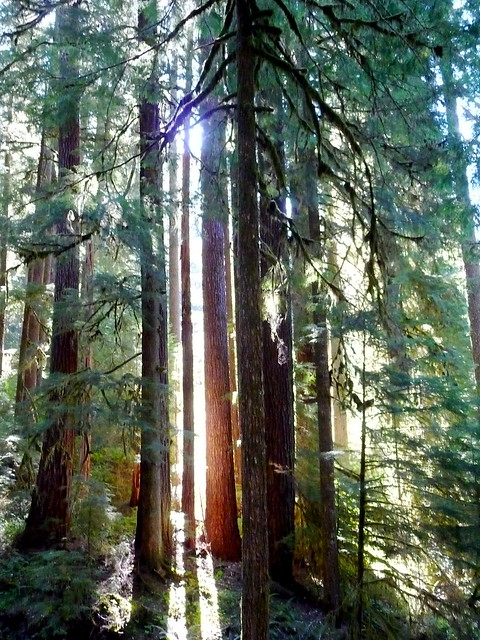
Una Pulgada Cuadrada de Silencio es un lugar en la Selva Tropical Hoh , parte del Parque Nacional Olímpico, posiblemente el lugar más tranquilo de Estados Unidos. Pero también está en peligro, protegido únicamente por una política que no practica el propio Servicio de Parques Nacionales ni cuenta con el respaldo de leyes adecuadas. Mi esperanza es que Una Pulgada Cuadrada provoque un despertar silencioso en todos aquellos dispuestos a escuchar con sinceridad.
Preservar el silencio natural es tan necesario y esencial como la preservación de especies , la restauración de hábitats, la limpieza de residuos tóxicos y la reducción del dióxido de carbono, por nombrar solo algunos de los desafíos inmediatos que enfrentamos en este siglo tan joven. La buena noticia es que rescatar el silencio puede ser mucho más fácil que abordar estos otros problemas. Una sola ley significaría una mejora enorme e inmediata. Dicha ley prohibiría que todas las aeronaves sobrevuelen nuestros parques nacionales más prístinos.
El silencio no es la ausencia de algo, sino la presencia de todo. Vive aquí, profundamente, en One Square Inch, en la selva tropical de Hoh. Es la presencia del tiempo, imperturbable. Se siente en el pecho. El silencio nutre nuestra naturaleza, nuestra naturaleza humana, y nos permite saber quiénes somos. Con una mente más receptiva y un oído más atento, nos convertimos en mejores oyentes no solo de la naturaleza, sino también de los demás. El silencio se puede transportar como las brasas de un fuego. Se puede encontrar el silencio, y el silencio puede encontrarte. El silencio se puede perder y también recuperar. Pero el silencio no se puede imaginar, aunque la mayoría de la gente lo crea. Para experimentar la maravilla del silencio, que llena el alma, debes escucharlo.
El silencio es un sonido, muchísimos sonidos. He escuchado más de los que puedo contar. El silencio es el canto del coyote a la luz de la luna, que canta en el aire, y la respuesta de su pareja. Es el susurro de la nieve que cae y que luego se derrite con un asombroso ritmo de reggae, tan nítido que querrás bailarlo. Es el sonido de los insectos alados polinizadores vibrando suaves melodías mientras se lanzan defensivamente entre las ramas de los pinos para escapar temporalmente de la brisa, una mezcla de zumbido de insectos y suspiro de pino que te acompañará todo el día. El silencio es la bandada de carboneros de lomo castaño y trepadores pechirrojos, piando y revoloteando, recordándote tu propia curiosidad.
¿Has oído llover últimamente? La gran selva tropical del noroeste de Estados Unidos, sin sorpresa, es un lugar excelente para escucharla. Esto es lo que escuché en One Square Inch of Silence. La primera lluvia de la temporada no es nada húmeda. Al principio, innumerables semillas caen de los imponentes árboles. A esto le sigue el suave aplauso de las hojas de arce, que se posan silenciosamente como un manto invernal para las semillas. Pero este concierto silencioso es solo un preludio.
Cuando llega la primera de muchas grandes tormentas, desatando su poderoso himno, cada especie de árbol produce su propio sonido en el viento y la lluvia. Incluso las gotas más grandes pueden no tocar el suelo. A casi 90 metros de altura, en lo alto del dosel del bosque, las hojas y la corteza absorben gran parte de la humedad... hasta que esta esponja aérea se satura y las gotas se recomponen y descienden más lejos... golpeando las ramas inferiores y cayendo en cascada sobre cortinas de musgo que absorben el sonido... golpeando los helechos epífitos... golpeando suavemente los arbustos de arándanos... y golpeando las duras y firmes hojas de salal... antes de que, finalmente, las gotas doblen inaudiblemente las delicadas hojas de la acedera, parecidas a tréboles, y goteando para filtrarse en el suelo. Escuchado de día o de noche, este ballet líquido continuará durante más de una hora después de que cese la lluvia.
Recordando la advertencia de Robert Koch, creador del método científico que identifica las causas de las enfermedades, creo que la pérdida descontrolada del silencio es una señal de alerta global. Si no podemos posicionarnos aquí, si hacemos oídos sordos al problema de la desaparición de la tranquilidad natural, ¿cómo podemos esperar una mejor respuesta ante crisis ambientales más complejas?
COMMUNITY REFLECTIONS
SHARE YOUR REFLECTION
6 PAST RESPONSES
Amazing Article ! The contents so described are soul touching and capable enough to arouse the inner feeling of a sincere reader and a thinking man...This was the reason why our great saints and Hermits used to leave the cities and towns and migrated to the valleys and on the lap of great mountains to find the eternal truth...They were realizing that Silence is Golden and its sound is rhythmic but one need to have a pair of sensitive ears to listen those vibrant music of the nature....We do not need instruments to accompany and throat breaking noise or sound to catch anybody's attention. Instead we will learn the melodious songs of cuckoos, bellowing of cattle and similar sounds which will never break any body's journey for the silence. It is certainly soul searching to enter into a silent place and keep on listening and looking....one will automatically immerse in the soul of the mother nature..How beautiful that moment would be....It is to be experienced...So be away from the madding crowd at least once in a week.. and enjoy the silent songs of the nature..which is God Gifted to us...let us also explore and experience those mesmerizing impact of the silence and natures songs like a lullaby sung by our mother during our childhood.....
[Hide Full Comment]Beautiful! I live in SW Colorado surrounded by national forest & wilderness. I was struck on 9/11 when all the planes were grounded by the silence. In Bali they have a day a year when no planes fly, transportation & commercial activity stops. 24/7 commerce & non-stop human activity is a plague. I experience great blessings in having moments where the inner Silence of conscious awareness & the outer silence of moments here on the outskirts of so-called civilization I hear nothing but the sounds of nature, even their activity stills at times. The lake frozen over functions as a sound chamber making eerie mystifying sounds. Something occurs in body & soul in the naturalness. We are such amazing beings of consciousness, love & light and of human spirit, and creatures of the natural world also. Stop to smell the roses. Taste the wind. Touch the bark of a tree, the pine needles softness. See the natural light of sun, moon & stars. And listen, listen from the quietness within. Let natural sounds penetrate you & see how that feels. Contact with Silence within and without restores us. There's so much to be heard from the still small voice to the hum of the hummingbird, the robin heralding spring. Ultimately it all informs us as well as restores us. Listen up, those with ears to hear. The resounding Word is everywhere in everything.
[Hide Full Comment]Thank you, DailyGood and Gordon Hempton, for this beautiful piece. I will return to it often. And some day I hope to visit One Square Inch. Remembering Phillip Levine, who passed away Saturday -- here's a stanza from one his poems, Our Valley, that honors the immensity of silence. Thank you Phillip Levine. Peace all.
"You probably think I’m nuts saying the mountains have no word for ocean,
but if you live here you begin to believe they know everything.
They maintain that huge silence we think of as divine,
a silence that grows in autumn when snow falls
slowly between the pines and the wind dies
to less than a whisper and you can barely catch
your breath because you’re thrilled and terrified."
Thank you for debunking the misconception that silence is soundless. I think that, ultimately, listening to silence is mindfulness, meditation, presencing ...
I live in the Pacific
[Hide Full Comment]Northwest, and have all my 58 years. I teach in a local high school, and
get to share yoga as a PE elective. I have had a long standing focus for
yoga that it is quiet and without music, which is viewed at first by the students
as unfair and unheard of. Students at
first are frightened and surprised by how loud their personal thoughts are in
the silence of the yoga room, and then begin to crave the absence of
technology-driven distraction. I teach walking classes as a PE elective,
and the students are not allowed to listen to music and plug their ears with
earbuds or headphones (for ‘exercise’ motivation if you can imagine), nor even
have their phones with them (some drop the class because they are unable to do
this). We are located within the noise
pollution radius of the freeway, an expanding airport, and relentless increases
in coal/oil trains. We walk sidewalks
along streets with cars whizzing by, in close proximity to the hospital
helipad, and recently drones just overhead.
I do though get to observe students begin to recognize bird sounds from
chickadees, sparrows, juncos, hummingbirds, cedar waxwings, robins, seagulls,
crows, starlings, and then the local peregrine chatter and if really lucky eagle
cries from a hundred feet up as they circle toward the river. The students begin to discern the difference
between dog barks of ‘Hello, I’m here, can we play?’ and ‘Get away’. They start entertaining the idea they are no
longer invisible and recognize community members walking, biking, and jogging by
using eye contact and saying the word ‘hi’.
They have the opportunity to acquire listening and empathy skills as
they spend an hour with a walking partner who is conversing with them in close
contact. I love my job. The real reason I am writing, though, is that
over the years of indiscriminant development and significant paving of
farmland-open space-forested land in my beloved slice of heaven, there is a
slogan perpetuated by the local military base whose flights overhead have
stepped up significantly in the past ten years that this continuous low flying
military jet noise is the sound of freedom…and this includes the flights toward
the Olympic Peninsula, as well as over the San Juan Islands, toward Mt. Baker,
over a multitude of local lakes and streams, tiny communities, and wildlife of
all types. You may be able to tell I
would argue with this as we continue to raise generation after generation void
of connection with nature, quiet places and spaces, and opportunities for
silence.