
Light, indeed, is the most important external cue to synchronize our internal body clocks, and the lack of light can have severe negative effects on our sleep patterns. Even a well-lit workplace exposes us to no more than 100 Lux, which translates to 1,200 Lux-hours over the course of a 12-hour workday. Meanwhile, on a cloudy day, the intensity of outside light is about 120,000 Lux, which means even a short 20-minute walk outdoors would expose us to 40,000 Lux-hours, or more than thirty-fold the exposure of that entire indoor workday. (Unless you have one of these lamps, which has been the single most important investment in my circadian sanity and general tolerance of dreary New York winters since my meditation practice.)
The detrimental effects of this light deprivation are most pronounced in the elderly and the mentally ill. Many elderly people rarely get a chance to go outside, and the TV is often their primary source of light. (Which leads one to wonder why elderly homes and assisted living facilities aren’t investing in such artificial daylight lamps rather than the countless flatscreen TVs gracing the common areas and even individual rooms in these institutions.)
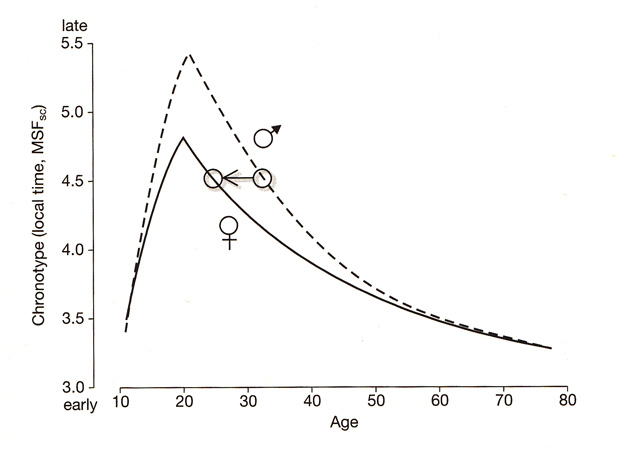
Across most ages, men are on average later chronotypes than women. The differences decrease as men and women age. Thus, when the man is older than his female partner, their chronotypes tend to be more similar.
Internal Time goes on to illuminate many other aspects of how chronotypes and social jet lag impact our daily lives, from birth and suicide rates to when we borrow books from the library to why older men marry younger women, and even why innovators and entrepreneurs tend to have later chronotypes. (One hypothesis: because they were more challenged in school than early types, and always had to invent clever strategies to help them perform despite not being on top of things.)
Roenneberg’s daughter put together this wonderful teaser for her father’s research:
(Thanks, Jalees.)
Ultimately, Roenneberg makes a powerful case against many of the social expectations we have around sleep and productivity:
I am often asked whether we cannot get used to given working hours merely through discipline and by confining our sleep habits to certain times. The assumption inherent in this question is that the human body clock can synchronize to social cues. I tend to find that any such questioner, who usually also displays a somewhat disdainful tone towards the weakness of late chronotypes, is an early type — someone who has never experienced the problems associated with the [desynchronized] sleep-wake behavior of late chronotypes.
COMMUNITY REFLECTIONS
SHARE YOUR REFLECTION
3 PAST RESPONSES
For me is like I don't follow patterns. I can be on 30 hours and while i can be asleep 8to 12 hours. normal times, 4 to 6 hours are enough. I am feeling sleepy. Thank you for the science.
and here is outside question...why does the man on the video is looking annoyed ? Is it about Asian Culture still ? Asian Culture should not influence your feelings.
I have wondered for some time if the fact that my mother did not like to go outside much contributed to her dementia. Some studies on vitamin D seem to show a link. If we really need as much as Hollis and others suggest, then most Northerner are very deficient. I choose to supplement and have my blood tested for optimal results.
I am not quite clear on what the "mean" time means. As a child and as a teen, I tended to go to sleep around 9 pm, and wake up at 5 ish to do my homework. These days I've been have a lot of trouble sleeping more than 5 or 6 hours (I am 60) and I tend to go to bed later. I wonder if returning to 9 or 10 PM would help me get 7 or 8 hours of sleep. Probably, it would.
The yellow quotation marks make the article very difficult to read. Please avoid this kind of styling in the future. Thank you.