
光线确实是同步我们生物钟最重要的外部信号,而缺乏光线会对我们的睡眠模式产生严重的负面影响。即使是光线充足的工作场所,我们每天接触到的光照强度也不超过100勒克斯,这意味着在12小时的工作日里,我们每天接触到的光照强度也只有1200勒克斯小时。而阴天时,室外光照强度约为12万勒克斯,这意味着即使只是短短20分钟的户外散步,我们每天接触到的光照强度也会达到4万勒克斯小时,是整个室内工作日光照强度的30多倍。(除非你拥有这样一盏灯,自从我开始冥想练习以来,这盏灯是我在保持昼夜节律正常和忍受纽约阴沉冬日方面最重要的投资。)
光照不足的危害在老年人和精神疾病患者身上最为显著。许多老年人很少有机会外出,电视往往是他们主要的照明来源。(这不禁让人疑惑,为什么养老院和辅助生活设施不投资购买人工日光灯,而是在公共区域甚至每个房间里摆放无数的平板电视。)
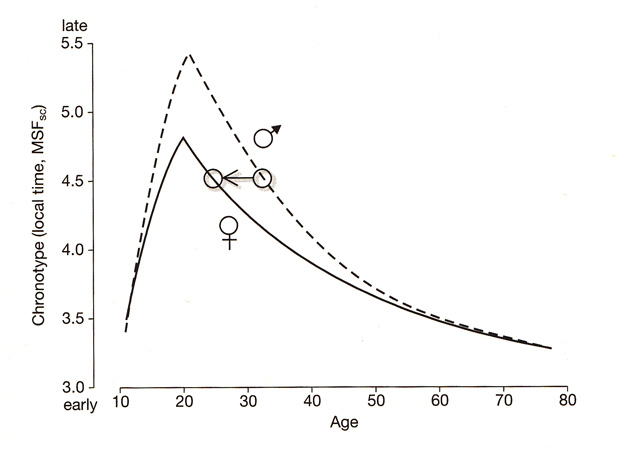
在大多数年龄段,男性的平均作息时间比女性晚。随着年龄的增长,这种差异会逐渐减小。因此,当男性比女性伴侣年长时,他们的作息时间往往更加相似。
《内在时间》一书进一步阐述了生物钟类型和社会时差如何影响我们的日常生活,从出生率和自杀率,到我们何时从图书馆借书,再到为什么年长的男性会娶年轻的女性,甚至还探讨了为什么创新者和企业家往往是晚睡晚起型。(一种假设是:因为他们在学校里比早睡早起型的人面临更多挑战,总是需要想出巧妙的策略来帮助自己在并非一切尽在掌握的情况下也能取得好成绩。)
罗恩伯格的女儿为她父亲的研究制作了这个精彩的预告片:
(谢谢Jalees 。)
最终,罗恩伯格有力地反驳了我们围绕睡眠和生产力所持有的许多社会期望:
我经常被问到,我们是否只能通过自律和将睡眠时间限制在特定时间段内来适应既定的工作时间。这个问题隐含的假设是,人体的生物钟可以与社会信号同步。我发现,提出这类问题的人通常对晚睡晚起的人抱有几分轻蔑,而他们自己往往是早睡早起的人——从未体验过晚睡晚起者睡眠-觉醒节律紊乱带来的种种问题。
COMMUNITY REFLECTIONS
SHARE YOUR REFLECTION
3 PAST RESPONSES
For me is like I don't follow patterns. I can be on 30 hours and while i can be asleep 8to 12 hours. normal times, 4 to 6 hours are enough. I am feeling sleepy. Thank you for the science.
and here is outside question...why does the man on the video is looking annoyed ? Is it about Asian Culture still ? Asian Culture should not influence your feelings.
I have wondered for some time if the fact that my mother did not like to go outside much contributed to her dementia. Some studies on vitamin D seem to show a link. If we really need as much as Hollis and others suggest, then most Northerner are very deficient. I choose to supplement and have my blood tested for optimal results.
I am not quite clear on what the "mean" time means. As a child and as a teen, I tended to go to sleep around 9 pm, and wake up at 5 ish to do my homework. These days I've been have a lot of trouble sleeping more than 5 or 6 hours (I am 60) and I tend to go to bed later. I wonder if returning to 9 or 10 PM would help me get 7 or 8 hours of sleep. Probably, it would.
The yellow quotation marks make the article very difficult to read. Please avoid this kind of styling in the future. Thank you.