
What if we measured wealth in terms of life, and how well we serve it?
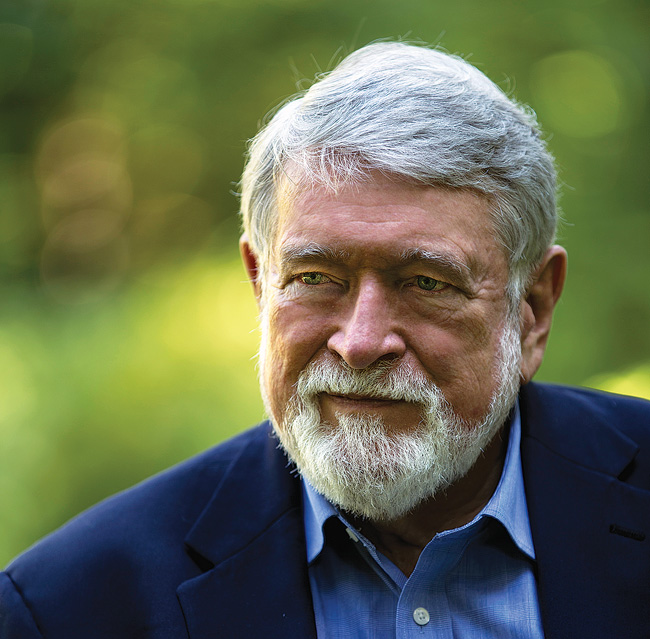
David Korten began his professional life as a professor at the Harvard Business School on a mission to lift struggling people in Third World nations out of poverty by sharing the secrets of U.S. business success. Yet, after a couple of decades in which he applied his organizational development strategies in places as far-flung as Ethiopia, Nicaragua, and the Philippines, Korten underwent a change of heart. In 1995, he wrote the bestseller When Corporations Rule the World, followed by a series of books that helped birth the movement known as the New Economy, a call to replace transnational corporate domination with local economies, control, ownership, and self-reliance.
This month, Korten, who is also the co-founder and board chair of YES!, publishes a new book challenging readers to rethink their relationship with Earth—indeed, with all creation, from the smallest quantum particle to the whole of the universe. The world needs “a new story,” he says. “If most species, including Homo sapiens, are to survive, we must recognize Earth as a living being.” Korten talked about his ongoing metamorphosis with YES! Executive Editor Dean Paton.
Dean Paton: Tell me how somebody who was an organizational management specialist, and then a new-economy thought leader, made this leap into what is as much a spiritual proposition as it is a political one—that Earth is a living organism, that we all are essentially a part of this one big life form.
“It comes back to this: Are we a part of nature? Or apart from nature?”
David Korten: It’s not that hard, actually—once you get into the living-Earth frame—to see that Earth is essentially this organization of living organisms creating and maintaining the conditions essential to life. If you’re an organizational expert, or theorist, that raises a really fascinating question: How do these millions of organisms work in concert to maintain life?
Paton: As if everything has an intelligence and everything has a purpose? How is that relevant to your new book, Change the Story, Change the Future?
Korten: The new book sets up the juxtaposition between the old “Sacred Money and Markets” story and an emerging “Sacred Life and Living Earth” story. They’re two totally different frames that lead to two totally different ways of thinking about organizing society. You either see life as a means to make money, or you see money as simply a number useful for keeping accounts in service to life, but of no value in itself. Buying into the “Sacred Money and Markets” story that money is wealth and the key to happiness locks us into indentured servitude to corporate rule.
Paton: You’re saying it’s the traditional development model, or transnational capitalism, that damages Earth as a living community, including not just humans but all life forms. Yet we all depend on money, on the market economy. Do you really think we can just stop that dependence?
Korten: We will still use money and markets, but strip away Wall Street’s control of money’s creation and allocation. There was a time in the United States when most of our financial institutions were local. Which essentially meant that local communities were able to create their own credit, or their own money, in response to their own needs. We still depended on banks, but it was a much more democratic process.
Paton: Like George Bailey’s building and loan in It’s a Wonderful Life.
“We humans live by stories.”
Korten: Exactly. If more of our money circulated in our communities rather than the Wall Street casino, it would facilitate people organizing locally to meet more of their economic needs with local resources. Control of money is the ultimate mechanism of social control in a society in which most every person depends on money for the basic means of living—food, water, shelter, heat, transportation, entertainment. This leads us into the voluntary simplicity movement: The less I’m dependent on money, the freer I am. Realize that the only legitimate purpose of the economy is to serve life, is to serve us as living beings making our living in co-productive partnership with living Earth.
Paton: How does that translate into actions? If we get a thousand people to say, “I’m a living being born of and nurtured by a living Earth,” how does that stop fracking? How does that stop the Russians from pumping all the oil out of Kazakhstan and selling it around the world?
Korten: It makes very clear that destroying the natural living systems on which our existence depends, in order to get a quick energy fix or a quick profit, is literally insane.
Paton: So if we’re all living beings “born of a living Earth,” as you say, where does that start to show up in our lives?
Korten: A big piece of it has to do with recognizing the implications of our dependence on money. This goes back to development as a process of separating people from their means of subsistence production. The more people become alienated from their self-production, the more they become dependent on money—and the more they become dependent on the people who control the creation and allocation of money.
Paton: You mean when I’m dependent, I accept fracking.
Korten: Yeah, you say, “I need that money. They’re going to pay me to frack my property.”
Paton: Do you really think Americans are going to be able to cast off the belief that money is king?
Korten: I’d say a lot of people are casting it off.
Paton: Most of us respond to a 10-dollar bill. Or a bonus at work. Or a new car.
Korten: But we respond to that because we accept the “Sacred Money and Markets” story that money is wealth, a fabrication that is literally killing us.
Paton: So you say that our choice is between working with Earth and working against her?
Korten: It comes back to this: Are we a part of nature? Or apart from nature?
Paton: Why do you insist we adopt this “Living Earth” story?
Korten: Because we humans live by stories.
Paton: And that means…?
Korten: It means that to organize as ordered societies, we need a shared framework—basic values and assumptions—so that when I relate to you, I’ve got some idea of how you’re going to respond, because we share our basic story.
Paton: Do we have a choice?
Korten: Yeah, change or die. Quite literally. You really can’t grasp the new story—as a society—and continue to live the way we live. First you begin to move toward more voluntary simplicity, which is, literally, reducing your dependence on money. You start doing more things yourself. You pay much more attention to your relationships, to the gift economy. You perhaps get a deeper sense of being part of and a contributor to a living universe evolving toward ever greater complexity, beauty, awareness, and possibility. What would that mean for society, and then what does it mean for how I live? What is my contribution to the change society needs? I have a responsibility to be part of this change—which begins by changing the story.
COMMUNITY REFLECTIONS
SHARE YOUR REFLECTION
5 PAST RESPONSES
"Are we a part of nature? Or apart from nature?"
This good question mirrors larger ones, such as, Are we a part of the divine? Or apart from the divine? Is our planet earth a part of the divine? Or is planet earth apart from the divine? What actually happens to us, to our humanity, and to all of life on our planet home when we believe and act as if the divine presence of God is never really present in our midst, that we cannot ever see, hear, touch, and know God right here, in this moment on this earth? Are we reserving all our seeing, hearing, touching, and knowing God for some next life, for some heaven beyond this present life?
What if God is here? What if God is under our noses, present within our own being, distinctly and separately contained in the loving wisdoms of two unique genders, alive in all the various races, colors, and cultures of people, within sexual orientation and identity, walking by, and also flying past, swimming in rivers and oceans, present in plants and insects - all facets and different aspects of the Universal One?
We seem so convinced that the divine is "out there", distant and foreign, looking down upon us. What if heaven has been waiting for us to bring it to life, right here on earth?
What would heaven be like? Would heaven have a hierarchy of superior and inferior people, or people superior to creatures, birds, fish, insects, plants, forests, oceans, and waters; human beings dominating over life, enslaving, re-engineering, genetically-altering, chemically-poisoning, and monetarily profiting from commodifying, exploiting, abusing, destroying, and killing human life and all of creation, and our own human hearts and souls in the bargain?
When Albert Eisstein was asked, What is the most important question in life, his answer was, "Is the universe a friendly place or not?"
[Hide Full Comment]Chasing and competing (even unto death) for fleeting, dissolving, and false monetary wealth blinds and pits all human beings (wittingly or unwittingly) against one another, and against all of life, and also crushes respect, love, genuine and true affection along the way, in regard to others and all of creation but also for one's self. Are we "making a living", but just existing, and not truly living? Can we compete our way into heaven, disrespecting and commodifying human work populations and all of life? Can we save our planet earth home, and the best in our humanity by disregarding and disrespecting both, in favor of non-lasting monetary rewards that are disappearing as quickly as we claim them, while they take away and destroy our true and lasting common wealth in the natural world of earth, lead us to suppress ground-breaking knowledge in natural processes and life-sustaining innovation, and stand in the way and block our ability to form healthy, respectful, cooperative relationships with one another and with all of creation? Is our existence on this earth nothing more than just a place to compete and win while trampling over others, dominating everyone and all of life, destroying the best of our own humanity and all of creation?
Perhaps the first, and truly most important, question is,
"Is the earth a friendly place or not?"
And, what have we formed it to be?
It has been said by George Simmel, German Sociologist, that money is the purest form of a tool. Since the tool is man made I suggest accounting for inherent worth wherein all possess natural worth.
Another contribution to changing the story.
"We are surrounded by a sea of free energy. Nikola Tesla and Dr. Thomas Henry Moray tried to educate the public to this good and free electromagnetic energy (EM energy) over 80 years ago that can be harnessed with a simple, even homemade, omnidirectional antenna. EM energy is infinitely supplied by our good universe, and it creates zero emissions. All the Egyptian pyramids are antennas, and more modern pyramids within our midst. Solar panels can be redesigned to harness this electromagnetic energy and supply free, unlimited, and carbon-free electrical energy." Get on it. Investigate. The info is out there. We need to reclaim our planetary earth home, if humanity and all of creation deserve a chance at continuing into a future full of abundance, joy, peace, free and good, priceless love and life.
from frenergy
[Tapping into 200 volts positive of free, unlimited and unmetered pure electrical energy]
Thank you for this good and necessary interview with David Korten.
A contribution to changing the story -
The goal is self-sufficiency. We need life skills asap.
Our real needs are actually simple - food, clothing, shelter, and local community connections.
We can all contribute to a new earth by literally beginning to be more and more self-sufficient, learning how to grow, harvest, and preserve our own food at the individual and local community level, planting organic gmo-free gardens, encouraging and supporting the creation of small local organic farms, and farmdens ["a farmden is more than a garden and less than a farm", horticulturist, Lee Reich], local fruit and nut trees and orchards etc, and learning best practices for organic growing and preserving of non-gmo vegetables, fruits, and herbs. Schools and universities could be growing and teaching their students necessary life skills, how to grow and harvest organic, vegetables, herbs, and orchards on their own campuses. We are wasting, actually also polluting chemically, enormous swatches of dead zone land in maintaining pristine-looking lawns, but often poisoned with "cides" that are dangerous to esp. children but also adults, animals, bird, bat, insect life, fish, and local water sources (from the runoff into groundwater or local streams and creeks etc), rather than front, back, and side yards, and common community lands that are contributing to organic food self-sufficiency and engaged with the growing-of-life-itself process. We could also be composting all vegetal and organic plant waste and restoring depleted soils, rather than putting it into garbage disposals and sewers. We could be planting native plants and trees to encourage and contribute to the health and well being of all plant, animal, insect, bird, and fish populations at the individual and local level. And rooftop farms and gardens are one dynamic solution [eg. Brooklyn Grange] enabling city dwellers to also begin the process of becoming food self-sufficient local towns and cities.
We could also be de-constructing archaic and wasteful, unsustainable housing construction, reclaiming the materials, but also restoring the soils and lands, and building our own houses esp. with natural earth and cob-building processes [eg. First Earth movie], passive solar, thermal mass, sustainable energies, revolutionary biotecture techniques [Earthship Biotecture] for heating and cooling, trapping and using rainwater, and treating sewage on site w natural earth knowledge and processes, etc. Very little or no furniture and unspoiled home goods should be going into land fills. All of it, the vast majority could be recycled, redesigned, repainted, reupholstered and re-imagined into new life by local peoples with the know-how and vision to reclaim it. Raw materials could also find new and glorious uses [eg. Wallace Detroit Guitars - Upcycled Guitars Made From Abandoned Homes]. Old doors and windows could be made into garden greenhouses and conservatories "to extend the growing season, and as a shelter for chickens and/ or quail" [from Off Grid World].
I am one generation away from grandparents who did know how to grow and preserve their own food, who had cold cellars on their properties, who knew how to design and sew their own clothes, and build their own houses, and they did it all at the local level. By building and supporting local community and local businesses, local banking or public local banks, we are creating real wealth in self-sufficient and self-sustainable lives, enjoying life and real living, sharing in the joy and abundance of growing and harvesting, and engaged with our neighbors, neighborhoods, and local community. We could become local towns and communities of handbikers, bike trails and bike lanes like Amsterdam in the Netherlands. We could ensure our community has, at least, one dynamic and exciting, welcoming and beautiful public square with native plants and trees etc. where people can gather to talk, engage, sit, stroll, enjoy an ice cream cone, watch and support local street performers entertain, maybe have local-truck businesses that visit, come and go, etc. on Friday night and Saturday like they do in Tuscan Italian towns.
A few decades ago while working together at a community bank, I worked with a co-worker and friend whose mother lived in Greece, and her Greek mother would come every summer to visit her daughter. The two of them would roam the stores looking at clothes they admired. Then, the Greek mother (actually a grandmother) would make the dress, skirt etc patterns herself, and sew the clothes that her daughter, my friend, had admired. Watching the two of them every summer, was ... almost miraculous. That elderly and sophisticated Greek grandmother had true life skills; she was self-sufficient, and it was marvelous. The clothes she sewed for herself and her daughter were absolutely fabulous; they both had THE most gorgeous and unique wardrobes, and it was all created with loving hands and overflowing generosity of heart.
Imagine if we were all so engaged in living, having a wealth of life skills at our fingertips,
[Hide Full Comment]what kind of loving and life-enhancing new earth we could be living, and bring forth?
This "Living Earth' story need to be heard by more people around the world. We are living in a world controlled by greedy big banks and big businesses whose only aim is the big profit! And the rest of the world is mindlessly succumbing to their mantra of materialism - consume, consume AND consume! Lets rethink at individual levels about our way of life and make a concerted effort to resist materialism and go back to a simplistic way of living, caring for the living earth, caring for your families and future generations, caring for the communities we live in.