
I was reading recently about the Dalai Lama. He was interviewed in The New Yorker and somebody asked him about his own personal death and he just shrugged and he said, "Change of clothing." [laughter] And that was sort of my experience when I went through leukemia and greatly liberating. But because I've had to bury so many kids, 183 kids and kids I loved and kids I knew and killed by kids I loved, I mean, boy, if death is the worst thing that can happen to you, brace yourself because you will be toppled. And the trick is not to be toppled. The trick is to compile a list of all of the fates that are worse than death, but also compile the list of all the things so numerous to list, all the things that are more powerful than death. You know, that's what Jesus did. Jesus sort of put death in its place.
Ms. Tippett: Was it after your diagnosis that you discovered the story about the desert fathers and mothers, the one word they meditated on was …
Fr. Boyle: Oh, God.
Ms. Tippett: I read that a couple of days ago as I was getting ready for this and it's been so helpful for me.
Fr. Boyle: Yeah. Whenever the desert fathers and mothers would get absolutely despondent and didn't know how they were going to put one foot in front of the next, they had this mantra and the mantra wasn't God and the word wasn't Jesus, but the word was today. That's sort of the key. There's a play off-Broadway right now called Now. Here. This. It's Now, period, Here, H-E-R-E, period, This. And that's kind of my — that's become my mantra. Lately, I'm big on mantras. So when I'm walking or before a kid comes into my office, I always say "Now. Here. This, Now. Here. This." So that I'll be present and right here to the person in front of me.
Audience Member: So I'm thinking that you've already told me the answer to this question, which is Now. Here. This. But I hear you, I am moved by your work. I am moved by the plight of the poor and I am here for a week and then I go back to my privileged life in Fairfield County, Connecticut. among my Unitarian Universalists co-congregates. What is the message? What is there to be done besides shrugging my shoulders and writing a check?
Fr. Boyle: Don't stop writing the checks, first of all [laughter]. I owe that to my board meeting that's happening right now.
Audience Member: OK. So I buy the indulgence and then what happens?
Ms. Tippett: Yeah.
Fr. Boyle: That's right [laughter]. OK. Um, you know, the answer really is kinship. Everybody's so exhausted by kind of the tenor of the polarity right now in our country and the division is the opposite of God, frankly. You know, I always think of Dives with Lazarus. Dives is in hell not because he's rich, but because he kind of refused to be in relationship with Lazarus, that that parable is not about bank accounts and heaven. It's really about us. And so, you know, what's on Jesus' mind, he says that all may be one. And that's kind of where we need to inch our way closer, that we imagine a circle of compassion, then we imagine nobody's standing outside that circle. You know, God created, if you will, an otherness so that we would dedicate our lives to a union with each other.
Audience Member: Thank you.
Ms. Tippett: You know, I just want to say that question you posed so beautifully is a question that weighs on me. I think so many people are carrying that question around right now and feeling pretty hopeless about it. I mean, it's an open question and …
Audience Member: Well, we're resisting the divide. We're resisting the divide, but we don't know how to do it.
Ms. Tippett: Right.
Audience Member: We, privileged.
Ms. Tippett: Right. Not even the idea that we should create circles of inclusion. We live so separately that we don't know how to start those relationships. But I — one thing we're not trained to do is — I love Rilke's idea about holding the questions, living the questions until one day you live into an answer. So I think when we don't have the answer immediately before us, we then despair. I wonder if part of our work now is to hold that question and to pose it with each other and then, in that way, maybe we become listeners together and we start to …
Audience Member: The Rilke piece is wonderful. Thank you.
Ms. Tippett: Oh, over here. Sorry.
Audience Member: I grew up in the city and was homeschooled because my parents feared for my safety. And I go to St. Vivian Church, and they don't touch the city because of their fear. And how do you combat the fear with love and compassion?
Fr. Boyle: Thank you for your question. Um, you know, I read once that, you know, the Beatitudes, the original language, was not "Blessed are" or "Happy are" the single-hearted or those who work for peace or struggle for justice. The more precise translation is "You're in the right place if …" And I like that better, you know, because it turns out the Beatitudes is not a spirituality. It's a geography. You know, it tells you where to stand. You're in the right place if you're over here.
So, you know, I come from Hollywood where we say, location, location, location [laughter], and it's about location. You really have to go out. But knowing that service is the hallway that leads to the ballroom, you know, you don't want to have service be the end. It's the beginning. It's getting you to the ballroom, which is the place of kinship, the place of mutuality, that place that everybody knows here.
When you go there, you go who is receiving from whom? Who's the service provider? Who's the service recipient? You know, you hear yourself say that. I know I'm here at the soup kitchen, but, my God, I'm getting more from this. You know, everybody knows this. But it doesn't happen unless you break out, you know, and fear is just fueled by ignorance. So you have to break out of our ignorance. We have to go to the place that frightens us, you know?
And — and I'm always admiring of employers, especially in the early days before we were kind of established, who would call us and I'd give a talk somewhere and an employer would call me and say, "OK, send me somebody. I'm scared, though." I said, "I get it." Then they'll love who they get, you know, some homie who's enormously eager and a good worker and then he'll call and say, "Send me somebody else like him too." But they had to take that, you know, look before you leap, but leap. Thanks.
Audience Member: I appreciate your personal stories, the interaction you have, but the young man on the steps and the like, but so many in the area where I come from, the way you deal with gangs is you incarcerate them. So how much of the interaction have you had with the justice system, the penal system, and how can we in communities that want to put these things and depersonalize them away can we do, can be done, societally, congregationally, personally?
Fr. Boyle: You know, I don't spend a lot of time in courts anymore except that I will always testify when asked and I'm asked a lot in death penalty sentencing cases where there's a gang member and I'm called in as a gang expert, because I oppose the death penalty. But I've never encountered — and I've probably done 50 of these across the country — I've never encountered somebody, a gang member, who's on the stand, a defendant, who in my estimation was not mentally ill.
The minute you start to hear the profile, and they always give you the profile, you go, wow, this is a deeply disturbed mentally ill person. No one wants you to say that. The prosecution refuses you to say anything like that. Even the defense says don't say anything like that. Why? Because then you're forced to in the face of somebody who's mentally ill, you can only have one response and that's compassion. And this freaks us out because, oh, what happens to responsibility and he knew what he was doing. Prosecutors always say to me, well, he could choose.
I go, gosh, you know, not all choices are created equal and a person's ability to choose is not created equal. I don't know. If we were more sensible, you know, at an early age, we'd be somehow infusing the kids with hope when they can't imagine their future and they're planning their funerals, or we'd heal kids who are so damaged that they can't see their way clear to transform their pain, so they continue to transmit it, or to deliver mental health services in a timely, effective, appropriate way. If we did those things …
[Applause]
Fr. Boyle: If as a society, we did those things, we wouldn't be at the place we're at.
Ms. Tippett: I'm Krista Tippett, and this is On Being — today, with Father Greg Boyle, on his longtime, unusually successful work with former gang members in Los Angeles. I interviewed him in the outdoor Hall of Philosophy at the Chautauqua Institution, and we also took some questions from the audience.
Audience Member: Hello. I probably have 50 questions and it would be interesting to see which one …
Fr. Boyle: Do 49 of them and …
Audience Member: Which one comes out. I teach in a community college on the West Coast and, kind of similarly, I teach culinary arts, so I see a whole range of individuals and hear stories that would cripple most of us, what people are dealing with. But I think one of my key questions for you is, when I hear you use the word homie, could you define what that means to you? As you give these talks around the country, I think about what are other people taking away from that word versus what it is that that word means to you.
Fr. Boyle: Yeah, you know, sometimes when I go to other parts of the country, I was on a radio show from Chicago where a caller came in who took quite exception to the word homeboy. You don't find that so much in Los Angeles. And no thought went into this at all, you know, that with a movie producer, I'm trying to get money out of him and he says, "What do you think I should do" and he had proposed a lot of ideas and I said, "Well, I don't know, why don't you buy this old abandoned bakery across the street. We'll call it Homeboy Bakery."
That's how much thought went into this. So I wasn't kind of measuring and calculating will this have. But in the end, I'm OK with it because it's sort of like walking in the door and coming out another door. You'll hear homeboys say, you know, "Hey, do you know Mr. Sanchez? You know, he's my math teacher." I said, "No, I don't." "Oh, that's the homie right there." It's a way of connecting.
In the end, it's a word that is soaked with kinship, you know, and if Mother Teresa says the problem in the world is that we've just forgotten that we belong to each other, there's the potential anyway, I think, for the word homeboy and homegirl to kind of say we're connected. It's a way of saying we belong to each other and it doesn't have to do with he's in my gang and he isn't. And that's why the homeboy community and homegirls as well are folks who experience this connection and sense of belonging with each other.
Audience Member: I'm particularly impressed with your using the words walking in the lowly places. That's where Jesus would stand. But the question I have is you also talk about the prophetic and the hilarious and I recall that, if you look at the Dalai Lama, Thomas Merton, many of them have this wonderful sense of joy, and you seem to have this sense of humor. I often find that peacemakers, peacekeepers, are so intense and the weight is so heavy that there's very little time for laughter. I would like to know how it comes that you have this wonderful spirit of joy or what I'd call healthy humor and could you explain a little bit how you got that?
Fr. Boyle: It's like I don't know who talked about it, like discussing humor is like dissecting a frog. You can do it, but the frog dies in the process [laughter]. So I don't know. I mean, again, it's about joy. My joy may be in you and your joy may be complete. You want to have a light grasp on life, you know. And then in the end, it's precisely those kinds of moments that teach you something.
I mean, real quickly, one of my favorites recently was Diane Keaton showed up for lunch at a Homegirl Café, the Oscar-winning actress, Annie Hall and Godfather movies. She's there with a regular guy who's there once a week. Her waitress is Glenda and Glenda's a homegirl, been there, done that tattooed, felon, parolee. She doesn't know who Diane Keaton is, so she's taking her order and Diane Keaton says, "Well, what do you recommend?" and Glenda rattles off the three platillos that she really likes and Diane Keaton says, "Oh, I'll have that second one. That one sounds good."
Then it was suddenly at that moment that something dawns on Glenda and she looked at Diane Keaton. She goes, "Wait a minute. I feel like I know you, like maybe we've met somewhere." And Diane Keaton decides to sort of deflect it humbly and say, "Oh, gosh, I don't know. I suppose I have one of those faces, you know, that people think they've seen before." And then Glenda goes, "No. Now I know. We were locked up together." [laughter].
And aside from the fact that that story absolutely took my breath away when I heard it and I don't believe we've had any further Diane Keaton sightings, now that I think of it, that in the end it's about something. It's about kinship. It's about Oscar-winning actress, attitude in a waitress, that you may be one. That's the whole thing, that God has created this otherness so that you might bump into each other and find that you're homies, that you were locked up together.
[Applause]
Ms. Tippett: I just want to say, as we close, you said at the beginning and I pushed back and said how hard that is, that the job is to be who God is in the world. As you tell these stories of this life you lead, you know, you told the story in your book and you touched on this a moment ago. You first arrived in the neighborhood and you expected people to come to you and you would walk around and that didn't work. It was when you started visiting people when they were in hospital or visiting people when they were in prison that they then acknowledged you as a member of the community.
That's so resonant with that beautiful passage in Matthew, Matthew 25, about, you know, God saying you visited me when I was sick, you clothed me, you fed me. And they said, when was that? When you fed, clothed, visited the least of these. So I think it's wonderful how you show that that is doable, incarnating this incarnational message at the heart of Christianity. And you probably are too humble to want to take that in.
Fr. Boyle: Well, thank you for that. But I also feel like, in the end, you know, it is about trying to imitate the kind of God you believe in and it's natural for us to push back on that. But the truth is, you know, we're so used to a God, a one-false-move God, and so we're not really accustomed to the no-matter-whatness of God, to the God who's just plain old too busy loving us to be disappointed in us. And that is, I think, the hardest thing to believe, but everybody in this space knows it's the truest thing you can say about God.
Ms. Tippett: I wondered if, in closing, you would read this little poem by the 14th-century Persian poet Hafiz, and why you put that in your book. And the fact that it's from the 14th century I love because it reminds us that we've always been this way as human beings.
Fr. Boyle: Yeah, I don't know why I put it in my book [laughter]. So now I'm living my nightmare of my interview with Krista Tippett [laughter], now proven myself shallow and uninteresting. Anyway, it's called "With That Moon Language."
"Admit something:
Everyone you see, you say to them, 'Love me.'
Of course you do not do this out loud, otherwise someone would call the cops.
Still, though, think about this, this great pull in us to connect.
Why not become the one who lives with a full moon in each eye
that is always saying,
with that sweet moon language,
what every other eye in this world is dying to hear?"Ms. Tippett: Thank you, Greg Boyle.
[Applause]
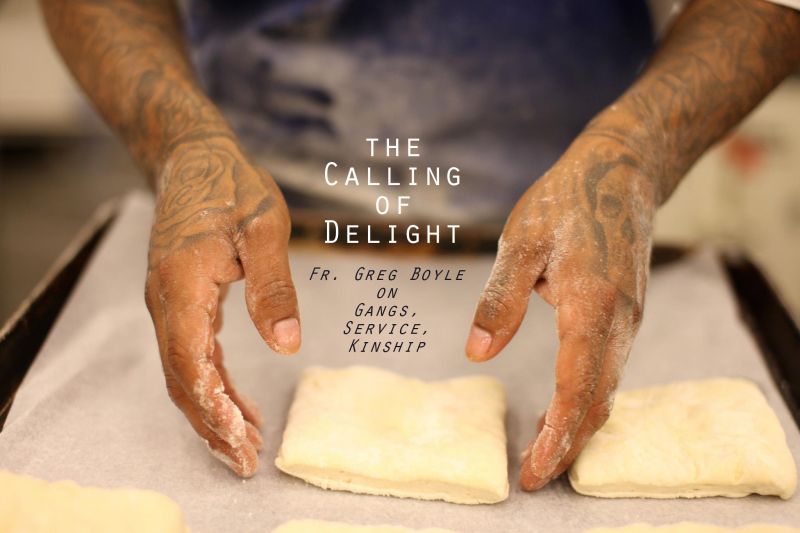
Ms. Tippett: Father Greg Boyle is founder and executive director of Homeboy Industries in Los Angeles. His memoir is Tattoos on the Heart: The Power of Boundless Compassion. Father Greg Boyle is an interesting voice in a moment of flux for the Roman Catholic Church. We're following this, and we'd like to hear your concerns, hopes, and dreams as a new pope is about to be elected. Tell us what you think at onbeing.org. There you can also listen again, download, and share this show with others.
You'll also find the On Being podcast, as always, on iTunes. On Twitter, use the hashtag "onbeing" and converse with other listeners. I'm there @kristatippett. Follow our show @beingtweets.
On Being on-air and online is produced by Chris Heagle, Nancy Rosenbaum, Susan Leem, and Stefni Bell. Special thanks this week to Maureen Rovegno, Joan Brown Campbell, and the Chautauqua Institution. Our senior producer is Dave McGuire. Trent Gilliss is our senior editor. And I'm Krista Tippett.
[Announcements]
Ms. Tippett: Next time, the Losses and the Laughter We Grow Into, with storyteller, humorist, and wise man Kevin Kling. Please join us.
This is APM, American Public Media.
COMMUNITY REFLECTIONS
SHARE YOUR REFLECTION
2 PAST RESPONSES
A beautiful interview on how to truly live & love in this world with compassion, kindness and kinship for Everyone. Thank you so much for sharing Father Greg Boyle's life's work.
truluy inspiring story.