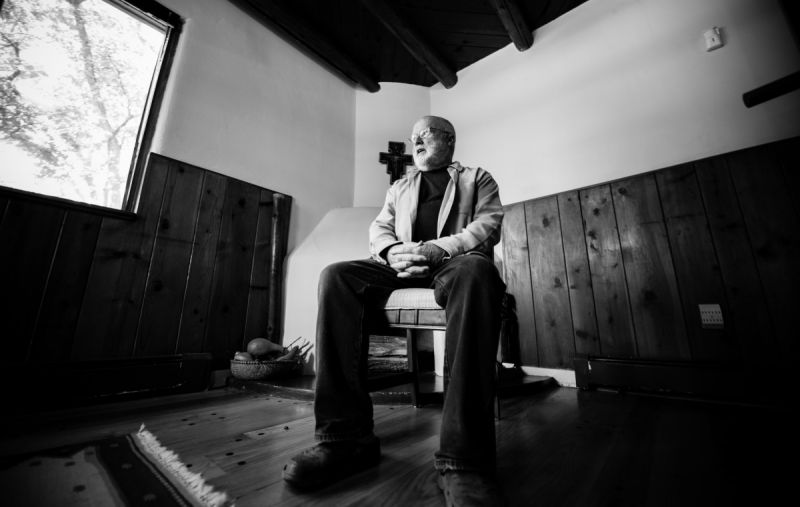

And I know that seems damning, but the male just can’t handle power unless he’s somehow touched upon vulnerability, powerlessness. And it’s no surprise that’s the first step of the 12-step program. So I created a five-day event. We started doing them here in New Mexico at Ghost Ranch in 1996 to try to compress what was often several weeks or several months, but I knew I could never get men away that long, to try to give them a distilled experience of classic male initiation. And as you said, the response has been overwhelming. It’s moved into 13 different countries now and so forth.
I just got an email from the Czech Republic right before I came over here about — they’re just ending them today outside of Prague, and 150 men are attending, and it’s very gratifying. So I’m grateful that God gave me a language that made sense to men, because a large percentage of men don’t even take religion seriously, with good reason.
[music: “Twins” by Matt Kivel]
Ms. Tippett: I’m Krista Tippett, and this is On Being. Today with Franciscan priest, writer and teacher, Richard Rohr.
[music: “Twins” by Matt Kivel]
Ms. Tippett: So I want to talk about some of the observations you make, some of the things you have heard and that are involved in your training, and actually I want to say it’s — you spent a number of years as a chaplain at the Albuquerque jail.
Fr. Rohr: Yes, 14 years.
Ms. Tippett: It seems to me that this formed, this intensified your sense of urgency around this also, around men.
Fr. Rohr: Around the male issue in particular. Krista, I was jail chaplain here, a few blocks from where I’m sitting right now, for 14 years, and if there was one universal I found among the men in particular, but certainly the young women too, was it was rare, if not never, to find someone in jail who had a good father. That’s what got me just driven toward — we’ve got to start growing up men because the male of the species does not know how to hand on his identity, his intimacy, his caring to his children.
And the rage in the young male who never had a dad or had an alcoholic father or emotionally unavailable father or abusive father is bottomless. It’s just — it moves out toward all of society, a mistrust of all authority, all authority figures, all policemen, of course, because — “If my dad abandoned me, I just basically don’t trust older men, and I don’t like older men.”
Now you can see what a bind this put us in when we defined God as masculine and called God “Father” exclusively. That’s one metaphor, but it is a metaphor. And so people who never had a loving male in their life, and we come along and say, “God, the Father, loves you,” they have no outlet to plug into, and that was my experience 14 years at the jail. I’d go in these cells, and I mean, these young guys would almost worship me because they’d never had an older man give them respect, give them attention, give them time.
Ms. Tippett: You used the language of “father hunger.”
Fr. Rohr: Yeah, father hunger. It’s driving so many things in our culture, even this whole corporate world of the younger male’s need to please the big daddy and get his pat on the back or his promotion.
Ms. Tippett: I think it’s such a mystery of the human condition.
Fr. Rohr: I know, I know.
Ms. Tippett: That also, in some place you describe someone speaking to you about this father hunger and kind of in the middle of their life and realizing, calling it, saying they realized it was a chasm, a canyon, the emptiness and pain left of a relationship with the father that wasn’t there. And the mystery that we can get very old, and that can still be with us. That this is not something that you just outgrow.
Fr. Rohr: No, no.
Ms. Tippett: And it’s incredible how we can be defined by these broken relationships across a lifespan.
Fr. Rohr: Yeah, I’ve had men older than me weep with me, still wanting a daddy, because they never had a father figure. It’s heartbreaking, really.
Ms. Tippett: You say something that I just want to understand, where you say that “when positive masculine energy is not modeled from father to son, it creates a vacuum in the souls of men, and into that vacuum demons pour.” And you say among other things, they seem to lose the ability to know how to read situations and people correctly. Why is that? Obviously, that can be crippling professionally, personally, but why — what is that connection?
Fr. Rohr: Here’s the answer that comes to mind now. I don’t know if it’s the best one. But young men who haven’t been validated by an older male — because we look to our same-sex parent for validation — and when dad doesn’t tell me I’m a man or a good man or acceptable son, I think your first 30 years of life are so frantic, you don’t have time to read inner emotions. Your emotional life — there’s no subtlety to it, there’s no nuance, there’s no freedom, there’s no grace, there’s no time.
I often see it in airports. In 46 years, I was on the road, and you’d see these people rushing through airports, neither looking to right or left, like a deer caught in the headlights. When you’re a deer caught in the headlights, trying to survive, I don’t think you develop an inner world. Do you understand? It’s just the whole life is externalized, and the soul is not born. And that’s why, again, suffering for so many becomes the only path because it’s the only thing strong enough to lead you into the world of grief, for example, or sadness or pain. And those tend to be the holes in the soul that awaken the inner world.
And so an important part of every initiation rite was grief work, letting men get in touch with their unfinished hurt and begin to talk about it with other men. That’s when the floodgates opened, and all of this success that they shined with externally they finally could admit was all a charade. Everything changed after that.
Ms. Tippett: I guess that’s another mystery of the human condition, that if we can let ourselves feel what we think might kill us, it’s the only way to grow to a place of being able to integrate it rather than be haunted by it.
Fr. Rohr: I have found in the men’s work that a lot of men are afraid to expose this to their wives. I’m not sure exactly why vulnerability is such a scary thing for a man. What I found on the men’s retreats and the male initiation rites is that when a certain level of trust, vulnerability was achieved, men found it more open to talk to another man about this than even a woman.
Now afterwards, they would go home and blurt it all out to their wife, too, but as much as they love their wife, I think so many men are afraid of looking weak or vulnerable around their wife or their girlfriend, yeah.
Ms. Tippett: Just coming back to this both/and thinking that is a quality of the second half of life, of spiritual deepening, you talk about this quality of “bright sadness” that in that deepening, there is a gravitas and a lightness both. Say a little bit about the bright sadness.
Fr. Rohr: I remember some of the times when I was most happy, after — I used to spend the whole of Lent in a hermitage alone, and I’d come back just sort of glowing, like a bliss ninny, for the next couple weeks. But when people would look at me, I remember again and again, they said, “Richard, you look sad.” And I said, “Oh my gosh, do I?” Because in fact, I’m feeling exactly the opposite. And I don’t know how that transferred to my face as sadness, but when you live at this deep time, deeper level of communion or love or grace or whatever you want to call it, there is a heaviness to it that — “Is the rest of the world not seeing what I’m seeing? Why are they so caught up in trivialities, and why are they making one another suffer so much?”
So it’s the strangest combination of being able to hold deep sadness and deep contentment at the very same time. So I discovered that in myself, and my most wonderful moments were also my most sad moments, which leads you to a kind of participation in what I called earlier “the one sadness,” that your very fact of enjoying grace and love carries with it a dark side that I didn’t deserve to know this, I didn’t earn this, and most people think I’m crazy if I try to talk about it. So the two intense emotions very often coexist in the contemplative mind.
So that’s what taught me this both/and world view, that opposites do not contradict one another. In fact, they complement and deepen one another.
Ms. Tippett: So recently, I took a break. I got some rest that I needed badly, and I was staying at a retreat center, and there was — actually, it was a meditation session I went to. And the person who was leading it read a passage from your book, Falling Upward and read the line — and it was about facing your shadow side as the only way to get bigger and deeper. And there was this sentence that I couldn’t stop thinking about, and I said, “I’m going to interview that guy in a couple weeks, and I’m going to ask him about this.”
Fr. Rohr: Well, I can’t wait to hear what it is. [laughs]
Ms. Tippett: [laughs] “I have prayed for years for one good humiliation a day, and then I must watch my reaction to it,” which sounds so uncomfortable. There’s nothing in me that wants to pray for one good humiliation a day.
Fr. Rohr: No, and there isn’t in me either. I just said that to that group of millennials two weeks ago. Some years ago, I started recognizing that I was getting an awful lot of adulation and praise and some people treating me far more importantly than I deserved. And I realized I was growing used to it, that the ego just loves all of this admiration and projection. And a lot of it was projection. And I didn’t want fame and well-knownness and guru status to totally destroy me, and so for me, this became a necessity, that I had to watch how do I react to not getting my way, to people not agreeing with me, to people not admiring me — and there’s plenty of them — and that I actually needed that. And so I do, I still, I ask God for one good humiliation a day, and I usually get it, one hate letter or whatever it might be. [laughs]
And then what I have to do, Krista, is I have to watch my reaction to it. And I’ve got to be honest with you, my inner reaction — I’m not proud to tell you — is defensive, is, “That’s not true. You don’t understand me.” I can just see how well-defended my ego is. And of course, even your critics — and I have plenty of them — at least 10 to 20 percent of what they’re saying is usually true.
Ms. Tippett: Right. [laughs]
Fr. Rohr: [laughs] And I’ll recognize that very thing she’s so angry at me for saying, I really could’ve said it better, and I didn’t use the right word. Now, a lot of Christians are trained to be what we call word police. They’re always getting you on the right word, and it does drive you crazy after a while. So I try to learn from my critics, and they’re often the best of teachers, frankly.
Ms. Tippett: There’s a question – I think this may be on your website – so let me start this way. I often come to this point in a conversation as we’re ending and will ask this huge, unanswerable question about just where somebody would start, about how your sense of what it means to be human has changed, has evolved, or is evolving. It seems to me that — you said right at the beginning of our conversation that a sense of God is all wrapped up with what it means to be human. There’s this question on your website, and I kind of feel like it’s connected to this, but I’d like for you to think, to reflect on it, what it means, in any case. “What if changing our perception of God has the potential to change everything?”
Fr. Rohr: The Latin poet Terence is supposed to have said, “Nothing truly human is abhorrent to me.” I think the truly human is always experienced in vulnerability, in mutuality, in reciprocity. When human beings try to deny their own vulnerability, even from themselves, when they cannot admit weakness, neediness, hurt, pain, suffering, sadness, they become very unhuman and not very attractive. They don’t change you; they don’t invite you. I think that’s why Brené Brown, perhaps you’ve interviewed her…
Ms. Tippett: Yes, I have.
Fr. Rohr: …why her work is having such influence. Because like few other people, she has brought this central, for me, as a Christian, central, divine, gospel notion of vulnerability to really begin to make sense to a lot of people. So that’s why I’m anxious to present the vulnerable God, which, for a Christian, was supposed to have been imaged on the cross. But again, we made it into a transaction. Transaction isn’t vulnerability anymore, really. Vulnerability transforms you. You can’t be in the presence of a truly vulnerable, honestly vulnerable person and not be affected. I think that’s the way we are meant to be in the presence of one another.
[music: “Stars Pt. 2” by Lowercase Noises]
Ms. Tippett: Richard Rohr is a Franciscan writer and teacher, and founder of the Center for Action and Contemplation in Albuquerque, NM. His books include Falling Upward: A Spirituality for the Two Halves of Life, and most recently, Divine Dance: The Trinity and Your Transformation.
[music: “Stars Pt. 2” by Lowercase Noises]
Staff: On Being is Trent Gilliss, Chris Heagle, Lily Percy, Mariah Helgeson, Maia Tarrell, Marie Sambilay, Bethanie Mann, Selena Carlson, and Rigsar Wangchuck.
Ms. Tippett: Our lovely theme music is provided and composed by Zoe Keating. And the last voice that you hear singing our final credits in each show is hip-hop artist Lizzo.
On Being was created at American Public Media. Our funding partners include:
The Fetzer Institute, helping to build the spiritual foundation for a loving world. Find them at fetzer.org.
Kalliopeia Foundation, working to create a future where universal spiritual values form the foundation of how we care for our common home.
The Henry Luce Foundation, in support of Public Theology Reimagined.
The Osprey Foundation, a catalyst for empowered, healthy, and fulfilled lives.
And the Lilly Endowment, an Indianapolis-based, private family foundation dedicated to its founders’ interests in religion, community development, and education.
COMMUNITY REFLECTIONS
SHARE YOUR REFLECTION