
Frank: We throw that word around in the Buddhist world a lot. We think of suffering as something big that’s happened to somebody else, like refugees fleeing Syria or children starving in an African country. Suffering is just our relationship to life. Suffering is when buy an iPhone, and the new model gets announced next week or falling in love with somebody and getting to know them better. All these things are suffering. It’s our relationship to conditions. One of the ways to talk about suffering is that we have different kinds of relationships to life. One way that we suffer is that we demand that life be different than it is. It’s this unquenchable thirst that things be other than they are, and so whatever is here is not enough. Then there's the opposite of that, which is a kind of aversion to life as it is -- we don't like the way things are, so we make an enemy out of everything and everyone. We stay in this perpetual cycle of suffering. The third is ignorance, and it’s the biggest form of it. Ignorance is not really seeing the way life is, and so I keep tripping and falling into the same hole.
Pavi Mehta: Listening to you talking about the work that you’ve done in a very specific realm of life feels like it applies to almost every dimension. I'm sure your book has reached all kinds of diverse audiences. Have you been surprised by any of the unexpected corners that have been receptive?
Frank: Again, I have to really give credit to my wife, because she's the one who really saw that there was a whole audience of people that could really benefit from the wisdom that we learn at the bedside of people who were dying.
I gave a talk at a program called ‘The Long Now’ in San Francisco, created by Stewart Brand, the Futurist. It’s normally a program for people who think in terms of trends -- 10,000 year trends. The audience for it is usually people who come on their laptops and iPads. It was really interesting to see everyone closing their laptops and putting away their iPads. They were riveted because the subject was so galvanizing. Death cuts through all of our pretensions and shows us what really matters. We don't have to wait until we're dying to learn the lessons that dying has to teach. That's why I wrote the book! It's about what you learn from dying that could help you live a life of meaning and integrity, a happier life.
Pavi: Wonderful! I have more questions, but I’m going to go to the caller in our queue.
Kozo: Hi, this is Kozo from Cupertino. And thank you so much for this call and the five invitations, Frank. I wanted to ask you a question about one of the invitations -- welcoming everything and resisting nothing -- but from a different point of view. I know a lot of that is dealing with people who are dying, and I’m wondering if you have ever seen it the other way around -- where people who are dying, are almost giving up. I think about some stories that I've heard where a married person whose spouse died and within 5 months, they're dead as well even though they were perfectly healthy before the spouse died. I'm wondering if you’ve experienced that or have any thoughts on that?
Frank: Beautiful question, Kozo, and thank you for bringing it up. I think this last part that you just mentioned is a really common phenomenon. You know partly it's also a result of the fact that they usually work really hard to take care of them, oftentimes sacrificing their own health in that process. There are multiple factors that lead to that outcome.
Yet, we know that there are some people in life who see death as the best solution for their problems. Life has become desperate and unlivable in many ways for them, and so they see death as a way to bring all that suffering to some kind of closure. I'm not so sure that we can promise people that death will end all our suffering.
There was an old Italian lady in our hospice, and whenever you would ask her, “How are you today?” She’d say, “Oh, I just want to die.” We had a running gag in the hospice and I said, “Well, you're not taking her seriously!” So I went and asked her, “How are you today, Grace?” She said, “Oh, I just want to die.” I said, “Grace, what makes you think that dying would be so good?” It was a counterintuitive question to ask. Grace said, “Well, at least I’ll get out.” And I said, “Get out of what, Grace?”
Grace was a devoted wife to her husband who was a truck driver. Every day she'd laid out his clothes, paid the bills, made all his meals, and when she was sick she couldn't imagine that he could take care of her, nor could her daughter. She was the giver, so she came to the hospital expecting she would die quickly. All I know is that a few days later Grace moved back home. and she lived in the care of her husband and daughter for another six months and died comfortably.
I think that sometimes it's really useful to inquire with people to let people know how much we care about their presence, and to really value the enormous healing power of human presence, which I sense you have a sense of Kozo.
Kozo: Thank you.
Pavi: Frank I feel like the work that you do calls out the ways in which we might be bluffing to ourselves about how we are serving, and to serve at someone's death bed requires a kind of authenticity. What has serving in this way taught you about true service?
Frank: That’s a great question. I was overzealous in the beginning, I thought I knew what was right for everyone else. A few years ago I had a heart attack when I was teaching a retreat for doctors and nurses, and that was really a great teaching. It was humbling, and I really saw what it was like to be on the other side of the street. One of the things that I learned in the course of my work is the value of humility. The other was to see myself in the other person, and I don't mean in some kind of a psychological projection. I mean to really see my own mother in this woman, Grace, that I was speaking of, and to see myself in her. This fundamentally shifts the way in which I serve. For me, service has always has always been about mutual benefit. To me, true service is to recognize the mutuality of this experience.
In Zen Center there is what they call a mountain seat ceremony when the new Abbot is installed, and students come forward and ask seemingly combative questions to test capacity to lead the community with compassion. At one ceremony a student came and asked, “What does spiritual practice have to teach me about taking care of others?” The Abbot shot back in a very Zen way, “What others? Take care of yourself.” The student responded, “Well how do I do that? How do I take care of myself?” And the Abbot said, “Well of course -- serve other people.” In other words: we’re in this boat together.
Pavi: That reminds me of the Dalai Lama’s quote, “Be Selfish. Be Generous.” I am going to our next caller here.
Alyssa: Hi, this is Alyssa in Seattle, and I want to thank you. This has been an absolutely amazing call. I have two questions. When you were speaking of endings, you said how you shape and deal with endings is how you can shape and treat the new beginnings. I wondered if you could go more in depth what you meant by that.Frank: The way in which we end one experience shapes where the next one begins. For example, you just had an argument with your partner or your best friend, and then you have to step into some other situation. What has been unresolved is there with you; you carry into the next moment. When I am in a hospital and move from one patient's room to the next, I have to make sure I bring some honorable closure with the patient in the room, even if they are in a coma. I then have to consciously step into the next room. I have this silly habit, when I go into a patient's room I look to see where the hinges are on the door. If they are on the right I step in with my right foot. It’s a way of me entering the room mindfully -- recognizing that I am crossing a threshold into a new world. Now we can’t always make it fully complete, so we have to promise ourselves we will come back to that later. I am angry now or I am upset now, but I am going to come back to later. It’s not compartmentalizing-- it’s a promise.
Alyssa: Yes -- I’m having to move and thinking of how I’m being when I am moving and going to the next place. It’s shifted my perspective and how I am dealing with it. Maybe I’m choosing something like openness, just being open and having that perception.
Frank: Right!
Alyssa: The other question I had was - it seems what I am hearing is that throughout there is this incredible - I don’t know if it is a gift you have - but of having in your story the right questions and actions. A lot of it seems like you have this incredible skill from your experience, but in your stories I was wondering if a lot of this comes through, not from you?
Frank: That's a very good way to say it. I think that you know when we're present and present means first of all I'm here, I'm available, my mind is not scattered. Presence is some other way to fullness of mind, and it has a palpable quality to it. Most of us have had some experience like this, and we tune in and make sense to a kind of inner guide. That inner guidance is coming from some archangels, and that might be someone's belief. In my case, it feels like it's an innate human quality that rises up in response to the situation. Curiosity arises as a kind of guidance; playfulness arises as a kind of guidance. These are essential human qualities that we all have in us. The challenge is to get quiet enough to be able to listen, to not be so full of our knowing that we don't actually tune in or listen to what it is that is emerging. That might be of real benefit in the situation. I sense that you are able to do that. You quiet yourself, calm yourself, and then see what you might intuitively know that wonderful sixth sense of intuition.
Pavi: Frank, what comes up for me listening to you and thinking about the stories and experiences that you've borne witness to is how you work with all that in such a way that it doesn't weigh you down. Is it the honorable closure you experience in your practice that allows you to not be paralyzed.
Frank: Sometimes I get lost, and that's just human. We're going to get lost and overwhelmed. We're going to get swept away by our sadness or grief, and I think to recognize that when I'm with somebody else who's suffering I am enabled to look at my own fear. I'm looking at my own grief all the time, so it's not like I'm one hundred percent over there with them. I'm actually keeping a percentage of my attention in my own experience. Second, I have to do practices which can help keep me balance. In the midst of the AIDS epidemic, sometimes I knew twenty, thirty people died in the week. It was an enormous source of grief in my life.
I would do three things to cope. The first thing is I went back to my meditation cushion to stabilize this experience to gain perspective. The second thing I did was visit a body worker once a week, and he was a really great guy. I would walk in his office and lay on a table and he would say, “Where should I touch today Frank?” I would point to my shoulder. He put his hand on my shoulder, and I would just weep for about an hour. I would get up from the table, and I would say see you next week. We hardly ever had a conversation. It was just that I needed that relational touch to help me contact and feel free to express the sadness that was in my life.
The third thing I did was I used to visit the maternity ward with some friends of mine where there were babies who were born to addicted mothers. These babies needed to be held, and so before I would go home to my own children, I would go to the hospital and hold these babies. I just stayed there with a loving presence to calm them down so they would be able to sleep. There was something about that tenderness and ability to nurture little babies. This helped me enormously in working with the suffering. Those practices were essential to me in that work to keep them kind of balanced and stay human and not become a technician.
People are doing this all over the place, and we talk about the problems of health are but gosh, I wish I could share with you the stories I have of nurses, home health aides, doctors, and social workers doing remarkable things beyond the scope of their job. One time, I witnessed a nurse’s assistant with the grunt job. After a code blue, his job was to clean up the room. The patient was still there, and he walked over to the patient, leaned over, and said, “You've died now, and I'm going to as respectfully as possible wash away all dust and confusion and bathe her body.’ We need to know that that kind of basic goodness is there.
Pavi: We have many people in this community work with at risk youth and children who have been going through all kinds of trauma, and I wonder, as someone who survived a troubled youth, if you have any words or guidance for them.
Frank: The complexity of trauma that children at risk are living through these days is devastating. It is mind boggling that people can still be walking around, but I only tell what helped me. Just love them until they can love themselves again. People loved me and showed me that it was possible to love myself, and so I borrowed their love.
Pavi: You mentioned the fact that the dying process is not a medical process, and it does its own work just like the birth process. Can you speak a little bit more about that?
Frank: We treat dying in this country and in many countries as if it was simply a medical event, and it is so much more than that. It is so much more profound, and there is no one single model that is large enough to embrace all that happens at the time of dying. Dying is much more about our relationship through love to suffering the experience of death itself to God or whatever image of ultimate kindness we hold. The work of being with dying is about attending to those relationships, and the first characteristic that we need in that relationship is mastery. We need to know what we're doing. I want a doctor and nurse with me who can manage my pain and control my symptoms. I need that but that won't be enough.
I need somebody who's going to be comfortable in the spirit of meaning to help me find out what the purpose and value of my life is. We trust and know that there are certain conditions in the dying process that are conducive to helping us wake up to our life. It strips away all of the identities and then we can now do something far more essential in our lives, something much more fundamental, true, and real. Dying shows us that we have a full rich life and again hopefully we step into our full hearts.
Pavi: What a profound reminder and inspiration to close on. We do have one final question that we ask all of our guests and that is, how can we as the extended ServiceSpace Awakin Call community serve you in what you're doing?
Frank: Serve me! Dying is an ordinary experience in that none of us get out of here alive. Let’s turn toward it, sit down with it, have a cup of tea with it, and get to know it really well. There's museums where there are great paintings hanging where we go on and on about a great artist. We want to be such places in our communities where people come to die, when we come to them we say, “please tell us how to live.” There's so many people living in nursing homes and residential care facilities that are totally alone. Go to one, sit next to somebody for a while and stare out the window with them.
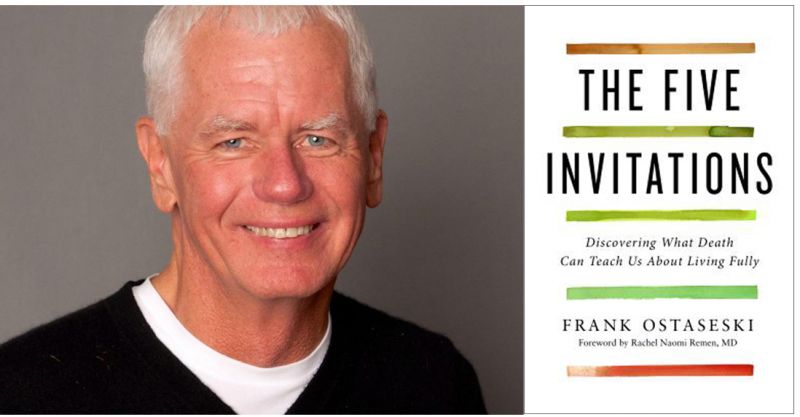
Personally you're very kind to mention this book, the “The Five Invitations” -- Buy it. I don’t need the money, but buy it, read it, share it with your friends. Get a group of people together, and talk about it. If you go to our website, there is a how-to guide for starting a book group. I wrote it to help people step more fully into their lives.
Pavi: We will definitely send out the links to the website and get the resources that you mentioned to all the people on this call. Before I close with a minute of gratitude, I wanted to say that it felt like speaking with you I wasn't just speaking with you. I felt like the spirit of all the people that you helped transition, all the care workers that you worked with, your wife who prompted you to write the book and get these messages out in the world was with us. Thank you for bringing them all into this conversation and enriching our lives through your generosity Frank.
Frank: They're my true teachers.
COMMUNITY REFLECTIONS
SHARE YOUR REFLECTION
5 PAST RESPONSES
Inspiring article.Thanks a lot
My small and intimate book group has been reading the book and everyone is enjoying the gifts of this author immensely! I will be reading this again and again! I also work in Hospice and this book has inspired me deeply in many ways.
Really great interview. I've learned a lot about death by loving and watching my pets live and die. I lost two sixteen year old dogs who had to be put to sleep and I found myself feeling guilty over doing it and guilty over waiting so long. But their emotions are so much like ours in their desire to be with their loved ones and they keep living right up until the last moment.
A beautiful conversation, true lessons for life (and death). "Don´t wait", "step into life with both feet". What a peaceful and active statement. Very grateful for this conversation. Thank you.
As a "Christian Buddhist" (a contemplative), I appreciate the love of this discussion. Timely after witnessing the passing (walk on) of my 94yr old mother-in-law. Peace, shalom even. }:- ❤️