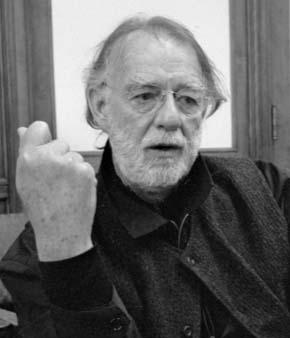
 One Friday Morning I Happened to Tune in to KQED’s Morning program <

RW: If you were to look closely enough, it must be that everyone has this experience, just a poetic experience of being here in the world which we have poor language for, but which is felt as the miraculous fact of life, the mystery and wonder of life. And we don’t have a culture that recognizes this or supports it. So it gets lost and people have to make a living. They fall under the mass ways of living and forget. Is this what you’re talking about?
GR: Yes. Because nobody teaches you to be an individual. Education could be much more dynamic and interesting. It should be something where people could create things that have never been seen or heard before. We’re here as creators. We’re really toolmakers, homo faber, as well as homo sapiens. We become what we do.
RW: Now let me ask you about the films. You’re the director and writer. Did you have particular visions? Did you have a camera? Did you…
GR: No. I don’t do anything like that.
RW: How did the vision come to you?
GR: By working with street gangs. I worked with street gangs for just over ten years. I realized that if you tell a kid that he’s [garbage], he’ll become [garbage]. If you tell a kid that he’s great, most of them will become great. If you give them a little love, if you offer them another structure in which to find themselves, if you ask them to give rather than to receive, if you ask them to be heroic, basically, then everything is possible!
I experienced that working with street gangs, people who others had thrown the book away on—their families, the school system, the court system. These were people who were on the streets, pachucos—people who were headed to the pinta, the penitentiary. I realized that most of them were fantastic. Sure there are a few people who are messed up, psychotic, if you want, or who have a social pathology. Most people just didn’t have a chance, and if you give people a chance, there’s no end of possibility. But after working in gangs for that long, I burnt myself out, severely. I had to leave. I realized I was spinning my wheels. It was an unending cycle of poverty that generates this.
So I wanted to speak to that condition, you’ll have to excuse me, in a metaphysical way, in a spiritual way, in a way that encompasses politics, because I started as an activist, an ultra-leftist, if you want. But I realized that most of that was aimed at who controls society rather than the structure of society, and that interested me very little. It motivated me to create film and that was terrifying to me because it was something I’d never done.
But I knew that film is like the new religion. I sit around in coffee shops and what are people talking about? Half of the time, movies! Movies are on everyone’s mind, but movies are taking you out of life rather than bringing you into it. It’s an entertainment form. We can entertain ourselves to death now, by doing nothing. I thought, gee whiz, that’s where everybody is. If I could only make a movie, the movie I had inside of myself. It was unspecified in the clarity of each shot, but I knew, for example, that I wanted to show the world as a living entity, as something alive with its own life force.
In the early 60s I had the good fortune to see Luis Bunuel’s film Los Olvidados (The Forgotten Ones). Brother Alexis Gonzales brought it to me and said, “Godfrey, you should really check this out for what you’re doing. It will blow your mind.” I said okay, and I saw it. I showed it to some of the members of a street gang I was working with, some of the young men and women, and it became, for all of us, a spiritual experience. It was touching us, not entertaining us. So this film, I guess I’ve seen it two hundred times. It became our ritual. We all looked at it many times. It motivated me. As a young brother, you don’t see movies, no Hollywood movies. The Lady of Lourdes maybe, every four months or so. But to see Bunuel’s film, it was like I had received a shock from heaven, or a lightning bolt! It shook me to the core.
RW: How old were you?
GR: I was twenty-three when I first saw it. I started working with gangs when I was twenty-one.
RW: When I saw Last Year at Marienbad it was like that. I was seventeen or so, and it was a revelation. Your story just reminds me of how much impact a film can have on one.
GR: It was so strong. I never related to the term “art” or “artist.” I live in a very artsy-fartsy community, very precious, Santa Fe, so I have an almost a knee-jerk reaction to the term, although a lot of my friends create what we call art. I felt that shock and awe, if it has a place at all, it is in the realm of art. Art, like religion, portends the divine. It portends inspiration. It is made, not for oneself, but to connect, to commune with other people. I felt that in Bunuel’s film. I felt touched by this man, albeit through a medium of technology.
RW: I heard a phrase the other day in regard to art that I really like, that art of the highest level is the apprehension of truth through feeling.
GR: Oh, beautiful! That’s what I was trying to say earlier. If you can’t feel something, you can’t give word to it. Please, it’s not anything I take credit for, but I grew up as a sensitive person, and I might say, quite a stupid one, also. I lived in New Orleans where racism was a way of life. It still is. I could never understand it—kids growing up with quote “nigger” jokes. I love my family, please understand me, but I grew up in a racist family. And, at least in my mind, I couldn’t understand this. What is this all about? We’re sitting in a church and all these beautiful people have to sit on a bench in the back! Or they have to sit in the back of the streetcar. I never could get my head around it, and if I had not had the audacity or the imprudence to leave home at thirteen, fourteen, I would have never gotten out of it. You have to kind of step out of your world to have a shot at not becoming a carbon copy of the world you live in. So, for me, it was a magnificent stroke of fortune that I, without knowing what I was doing, stepped out of life and entered another world completely.
RW: Into the monastic order.
GR: It wasn’t a monastic order. I was in a religious community, what’s called an apostolic order, with not only a religious life, but also a work to do in the world. In our case it was to teach the poor gratuitously. The Christian Brothers. When I went in, it was a pretty strict order.
RW: Just to follow up again. You said that the vision for doing this film came from working with street gangs. Then you described watching Los Olvidados over and over again. So I gather that something in that made you see that film was the modality to pursue.
GR: I felt it was something I could grab onto, because it moved me so much. I was never interested in having a film career. I made a tactical choice of film. I don’t want to deal with cameras or editing machines. I deal in the realm of feeling, and try to give voice to it.
RW: Was it your idea for your films to get rid of the foreground—the story, the plot, the actors—which had always been the main focus, and concentrate only on the background?
GR: Oh, yes. All of that is my idea, and also that it would be image and music. That’s what I mean. Those are the things that I do. I mean, when I announced to my crew that Phillip Glass was the composer I absolutely wanted, there wasn’t a person in the group who thought it was a good idea. They thought he was the master of the broken needle. I won’t name the folks, because they’re my dearest friends. They said, “But Godfrey, Phillip Glass, it’s just this repetitive stuff. You could have Beethoven, Mozart, Chopin—the Greats of All Time! And I said, well, I don’t know these guys, and they’re dead. And I just love Phillip’s music! It moves me. I said that he could write an original composition, and that I’d be able to talk to him! He’d come up with inspiration, and that’s been the basis of our collaboration. When the film was finished, there wasn’t a person in the crew who thought the film would ever be seen.
I was doing the film in Venice, California. My friends thought I’d gone off the deep end, was cracking up—seven years on a project that was going nowhere. And I brought it to Santa Fe, and its first showing was at our major theatre, the Lensic. Two thousand showed up! The theater held eight hundred. They had to have additional showings. And the place went ballistic. My crew was so happy and, of course, I was, too.
I’d kept my confidence for this film. I believed in it, and I knew it had to be made with a consummate level of technique if it were to have any chance in the world. I was willing to take on the contradiction of using technology to criticize technology. That got me a lot of early criticism. Many people didn’t give me money because they thought that was hypocritical.
RW: There’s a particular image in your second film that stands for me as perhaps the most searing image I’ve ever seen in any film. It’s a little girl driving this great cart and whipping this horse. Where did that come from?
GR: Oh, yes. I’m getting goose bumps as you say it, Richard. It comes from Cairo. That little girl is a member of a Coptic Christian community, which is a minority in Cairo and discriminated against heavily. These people live at the dump in Cairo. They’re extremely poor. They come out from the dump at about three or four in the morning to start making their rounds through the city. Of course, they don’t have motorized vehicles. Kids at the age of eight are already adults there. They have to take care of their siblings, or work. That particular kid was with her father. They were coming back at about two in the afternoon after having been out since four in the morning picking up garbage.
Allen, one of the producers and an assistant director, came back one day very excited. He said, “Gee, Godfrey, we saw this incredible event today. We couldn’t get it, but if we go back there tomorrow, I’m positive we can get it!” And that’s what I mean about collaboration. He went with Graham Berry and set up and got this kid, who was beating this donkey because the horns were blowing all around her. She wasn’t being cruel; it was what she needed to do to move to the side of the traffic. Her father looked dead, but he was sleeping from exhaustion.
RW: Well, that image sort of summarizes Powaqqatsi for me, I guess, that there’s this force eating us in life. I don’t exactly want to end on that note, but I don’t really know what to follow that up with.
GR: No, that’s a very searing image. It’s kind of a stopper. When I saw that (when we were making that film, we’d carry portable projectors with us and we’d look at the dailies once a week), and when all of us saw it, some of us were just moved to tears. It just took us down. It’s not that it just has one message. It has a kind of multi-verse of possibilities. It speaks to many people.
COMMUNITY REFLECTIONS
SHARE YOUR REFLECTION
4 PAST RESPONSES
I remember seeing Koyaanisqatsi as a Junior in college and it never left my mind. Thank you for reminding us that there are so many possibilities in this world and we have choice to change our narrative at any time. This is the work I do as a Cause-Focused Storyteller, who currently serves part time at the World Bank as a Storytelling Consultant to serve them to tell a different story; to see the human beings behind their data. PS. It's working <3
And now . . . I must see these films.
There is another way of living. There has been another way of living. And it worked for millennia before us.
I have a limited view, having been raised in this culture. And that view does not allow me to see getting to another way of living without great turmoil, as we are now beginning to see. Perhaps that's just the way it is with us.
I am not an optimist, but I do have hope that we can make our way to another way of living...after. It will take work and wisdom. I hope we're up to it.
For the past 25 years, I've been a successful freelance travel writer. I also conduct writing workshops, teach memoir and travel writing at a local university, and coach writing clients. In college, I took only one English course, freshman 101. My degree is a BS in Animal Science. No one has asked to see that degree since my first job application many years ago. Follow your heart!