
Another Western hegemony in the culture of grief, O’Rourke notes, is its privatization — the unspoken rule that mourning is something we do in the privacy of our inner lives, alone, away from the public eye. Though for centuries private grief was externalized as public mourning, modernity has left us bereft of rituals to help us deal with our grief:
The disappearance of mourning rituals affects everyone, not just the mourner. One of the reasons many people are unsure about how to act around a loss is that they lack rules or meaningful conventions, and they fear making a mistake. Rituals used to help the community by giving everyone a sense of what to do or say. Now, we’re at sea.
[…]
Such rituals … aren’t just about the individual; they are about the community.

Craving “a formalization of grief, one that might externalize it,” O’Rourke plunges into the existing literature:
The British anthropologist Geoffrey Gorer, the author of Death, Grief, and Mourning, argues that, at least in Britain, the First World War played a huge role in changing the way people mourned. Communities were so overwhelmed by the sheer number of dead that the practice of ritualized mourning for the individual eroded. Other changes were less obvious but no less important. More people, including women, began working outside the home; in the absence of caretakers, death increasingly took place in the quarantining swaddle of the hospital. The rise of psychoanalysis shifted attention from the communal to the individual experience. In 1917, only two years after Émile Durkheim wrote about mourning as an essential social process, Freud’s “Mourning and Melancholia” defined it as something essentially private and individual, internalizing the work of mourning. Within a few generations, I read, the experience of grief had fundamentally changed. Death and mourning had been largely removed from the public realm. By the 1960s, Gorer could write that many people believed that “sensible, rational men and women can keep their mourning under complete control by strength of will and character, so that it need be given no public expression, and indulged, if at all, in private, as furtively as . . . masturbation.” Today, our only public mourning takes the form of watching the funerals of celebrities and statesmen. It’s common to mock such grief as false or voyeuristic (“crocodile tears,” one commentator called mourners’ distress at Princess Diana’s funeral), and yet it serves an important social function. It’s a more mediated version, Leader suggests, of a practice that goes all the way back to soldiers in The Iliad mourning with Achilles for the fallen Patroclus.
I found myself nodding in recognition at Gorer’s conclusions. “If mourning is denied outlet, the result will be suffering,” Gorer wrote. “At the moment our society is signally failing to give this support and assistance. . . . The cost of this failure in misery, loneliness, despair and maladaptive behavior is very high.” Maybe it’s not a coincidence that in Western countries with fewer mourning rituals, the bereaved report more physical ailments in the year following a death.
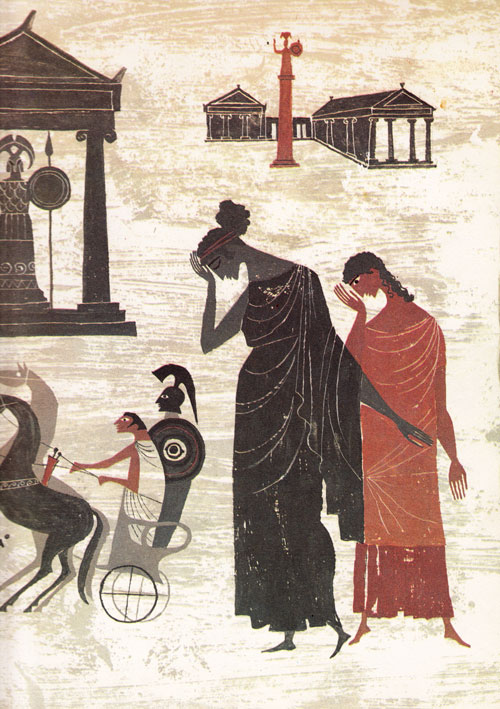
Illustration from 'The Iliad and the Odyssey: A Giant Golden Book' by Alice and Martin Provensen.
Finding solace in Marilynne Robinson’s beautiful meditation on our humanity, O’Rourke returns to her own journey:
The otherworldliness of loss was so intense that at times I had to believe it was a singular passage, a privilege of some kind, even if all it left me with was a clearer grasp of our human predicament. It was why I kept finding myself drawn to the remote desert: I wanted to be reminded of how the numinous impinges on ordinary life.
Reflecting on her struggle to accept her mother’s loss — her absence, “an absence that becomes a presence” — O’Rourke writes:
If children learn through exposure to new experiences, mourners unlearn through exposure to absence in new contexts. Grief requires acquainting yourself with the world again and again; each “first” causes a break that must be reset… And so you always feel suspense, a queer dread—you never know what occasion will break the loss freshly open.
She later adds:
After a loss, you have to learn to believe the dead one is dead. It doesn’t come naturally.

Among the most chilling effects of grief is how it reorients us toward ourselves as it surfaces our mortality paradox and the dawning awareness of our own impermanence. O’Rourke’s words ring with the profound discomfort of our shared existential bind:
The dread of death is so primal, it overtakes me on a molecular level. In the lowest moments, it produces nihilism. If I am going to die, why not get it over with? Why live in this agony of anticipation?
[…]
I was unable to push these questions aside: What are we to do with the knowledge that we die? What bargain do you make in your mind so as not to go crazy with fear of the predicament, a predicament none of us knowingly chose to enter? You can believe in God and heaven, if you have the capacity for faith. Or, if you don’t, you can do what a stoic like Seneca did, and push away the awfulness by noting that if death is indeed extinction, it won’t hurt, for we won’t experience it. “It would be dreadful could it remain with you; but of necessity either it does not arrive or else it departs,” he wrote.
If this logic fails to comfort, you can decide, as Plato and Jonathan Swift did, that since death is natural, and the gods must exist, it cannot be a bad thing. As Swift said, “It is impossible that anything so natural, so necessary, and so universal as death, should ever have been designed by Providence as an evil to mankind.” And Socrates: “I am quite ready to admit … that I ought to be grieved at death, if I were not persuaded in the first place that I am going to other gods who are wise and good.” But this is poor comfort to those of us who have no gods to turn to. If you love this world, how can you look forward to departing it? Rousseau wrote, “He who pretends to look on death without fear lies. All men are afraid of dying, this is the great law of sentient beings, without which the entire human species would soon be destroyed.”
And yet, O’Rourke arrives at the same conclusion that Alan Lightman did in hissublime meditation on our longing for permanence as she writes:
Without death our lives would lose their shape: “Death is the mother of beauty,” Wallace Stevens wrote. Or as a character in Don DeLillo’s White Noise says, “I think it’s a mistake to lose one’s sense of death, even one’s fear of death. Isn’t death the boundary we need?” It’s not clear that DeLillo means us to agree, but I think I do. I love the world more because it is transient.
[…]
One would think that living so proximately to the provisional would ruin life, and at times it did make it hard. But at other times I experienced the world with less fear and more clarity. It didn’t matter if I was in line for an extra two minutes. I could take in the sensations of color, sound, life. How strange that we should live on this planet and make cereal boxes, and shopping carts, and gum! That we should renovate stately old banks and replace them with Trader Joe’s! We were ants in a sugar bowl, and one day the bowl would empty.
A Perseid meteor over Joshua Tree National Park (Image: Joe Westerberg / NASA)

This awareness of our transience, our minuteness, and the paradoxical enlargement of our aliveness that it produces seems to be the sole solace from grief’s grip, though we all arrive at it differently. O’Rourke’s father approached it from another angle. Recounting a conversation with him one autumn night — one can’t help but notice the beautiful, if inadvertent, echo of Carl Sagan’s memorable words — O’Rourke writes:
“The Perseid meteor showers are here,” he told me. “And I’ve been eating dinner outside and then lying in the lounge chairs watching the stars like your mother and I used to” — at some point he stopped calling her Mom — “and that helps. It might sound strange, but I was sitting there, looking up at the sky, and I thought, ‘You are but a mote of dust. And your troubles and travails are just a mote of a mote of dust.’ And it helped me. I have allowed myself to think about things I had been scared to think about and feel. And it allowed me to be there — to be present. Whatever my life is, whatever my loss is, it’s small in the face of all that existence… The meteor shower changed something. I was looking the other way through a telescope before: I was just looking at what was not there. Now I look at what is there.”
O’Rourke goes on to reflect on this ground-shifting quality of loss:
It’s not a question of getting over it or healing. No; it’s a question of learning to live with this transformation. For the loss is transformative, in good ways and bad, a tangle of change that cannot be threaded into the usual narrative spools. It is too central for that. It’s not an emergence from the cocoon, but a tree growing around an obstruction.
In one of the most beautiful passages in the book, O’Rourke captures the spiritual sensemaking of death in an anecdote that calls to mind Alan Lightman’s account of a “transcendent experience” and Alan Watt’s consolation in the oneness of the universe. She writes:
Before we scattered the ashes, I had an eerie experience. I went for a short run. I hate running in the cold, but after so much time indoors in the dead of winter I was filled with exuberance. I ran lightly through the stripped, bare woods, past my favorite house, poised on a high hill, and turned back, flying up the road, turning left. In the last stretch I picked up the pace, the air crisp, and I felt myself float up off the ground. The world became greenish. The brightness of the snow and the trees intensified. I was almost giddy. Behind the bright flat horizon of the treescape, I understood, were worlds beyond our everyday perceptions. My mother was out there, inaccessible to me, but indelible. The blood moved along my veins and the snow and trees shimmered in greenish light. Suffused with joy, I stopped stock-still in the road, feeling like a player in a drama I didn’t understand and didn’t need to. Then I sprinted up the driveway and opened the door and as the heat rushed out the clarity dropped away.
I’d had an intuition like this once before, as a child in Vermont. I was walking from the house to open the gate to the driveway. It was fall. As I put my hand on the gate, the world went ablaze, as bright as the autumn leaves, and I lifted out of myself and understood that I was part of a magnificent book. What I knew as “life” was a thin version of something larger, the pages of which had all been written. What I would do, how I would live — it was already known. I stood there with a kind of peace humming in my blood.

A non-believer who had prayed for the first time in her life when her mother died, O’Rourke quotes Virginia Woolf’s luminous meditation on the spirit and writes:
This is the closest description I have ever come across to what I feel to be my experience. I suspect a pattern behind the wool, even the wool of grief; the pattern may not lead to heaven or the survival of my consciousness — frankly I don’t think it does — but that it is there somehow in our neurons and synapses is evident to me. We are not transparent to ourselves. Our longings are like thick curtains stirring in the wind. We give them names. What I do not know is this: Does that otherness — that sense of an impossibly real universe larger than our ability to understand it — mean that there is meaning around us?
[…]
I have learned a lot about how humans think about death. But it hasn’t necessarily taught me more about my dead, where she is, what she is. When I held her body in my hands and it was just black ash, I felt no connection to it, but I tell myself perhaps it is enough to still be matter, to go into the ground and be “remixed” into some new part of the living culture, a new organic matter. Perhaps there is some solace in this continued existence.
[…]
I think about my mother every day, but not as concertedly as I used to. She crosses my mind like a spring cardinal that flies past the edge of your eye: startling, luminous, lovely, gone.
COMMUNITY REFLECTIONS
SHARE YOUR REFLECTION
1 PAST RESPONSES
My wife was murdered, quite suddenly. I was left with 2 children who were 4 and 6 at the time. In these extracts there is so much desperation and darkness.
In my experience, you start to learn to adjust, to accept, because where does this deep dark despair take you? And wouldnt your loved one, want you to see light at the end of the tunnel!
9 years on, my children are as well adjusted as any other children. I learnt to become a 'Mother' as well as a Father, and most importantly, we all live life to the fullest.
And , I believe, that is our deep purpose, to experience all the wonderful things life has to offer.
We make the most of every minute of every day, and our lives are the richer for it.
And my wife?
Well I believe she is always with us, watching, guiding us, and revelling in the way we embrace life